


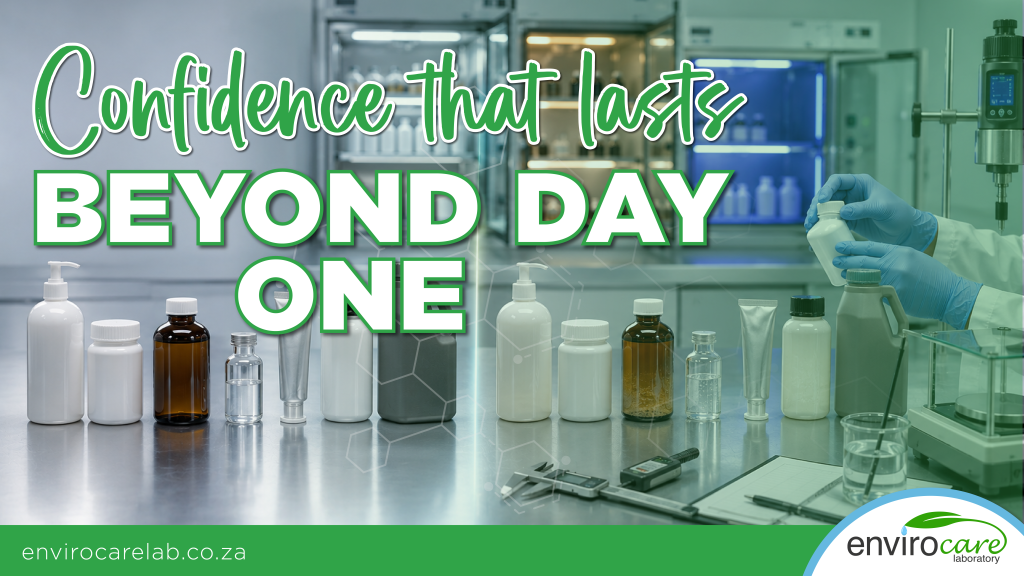
Understanding Product Stability, Shelf Life and Packaging Compatibility
A product may meet all its quality requirements when it is manufactured, but how will it perform after weeks or months of storage?
Changes in temperature, humidity, light exposure and storage conditions can influence a product’s physical and chemical characteristics. Packaging materials can also interact with a formulation, potentially affecting its appearance, consistency, quality and suitability for use.
For manufacturers, understanding these changes is an important part of product development, quality assurance and shelf-life evaluation.
Envirocare Laboratory offers stability testing and packaging compatibility testing in South Africa, supporting manufacturers and product developers across the cosmetics, personal care, pharmaceutical, veterinary and chemical industries.
Our testing services help assess how products respond to defined storage conditions and identify potential changes that may affect their quality over time.
What Is Stability Testing?
Stability testing evaluates how a product’s characteristics change over a specified period under defined environmental and storage conditions.
The objective is to determine whether a product maintains its intended physical and chemical properties throughout its proposed shelf life.
Depending on the formulation and testing requirements, stability assessments may include monitoring:
- Physical appearance and colour.
- Odour.
- Texture and consistency.
- pH levels.
- Viscosity.
- Phase separation or changes in formulation.
- Other relevant physical and chemical characteristics.
The testing parameters should be selected according to the product type, formulation and manufacturer’s quality requirements.
Why Is Product Stability Testing Important?
Products may undergo physical or chemical changes during storage, transportation and handling. These changes can influence product performance, appearance and overall quality.
Stability testing provides manufacturers with information to support:
- Shelf-life evaluation: Investigating how long a product maintains its specified quality characteristics.
- Product development: Assessing new formulations and identifying potential formulation-related concerns.
- Quality assurance: Monitoring changes in product characteristics during storage.
- Formulation improvement: Identifying potential weaknesses that may require further investigation.
- Packaging selection: Evaluating whether the intended packaging is suitable for the product.
- Manufacturing consistency: Supporting quality-control decisions for existing formulations.
Stability data can therefore contribute to informed product-development and quality-management decisions.
Types of Stability Testing
Different stability-testing approaches can be used depending on the product, its intended storage conditions and the manufacturer’s objectives.
1. Accelerated Stability Testing
Accelerated stability testing exposes products to selected environmental conditions, such as elevated temperatures, to investigate potential changes over a shorter period.
These conditions can help identify formulation weaknesses and provide useful information about how a product may respond to environmental stress.
Accelerated testing is particularly useful during product development when manufacturers want to investigate potential stability concerns before completing longer-term studies.
However, accelerated results should not automatically be treated as a direct replacement for real-time stability data.
2. Real-Time Stability Testing
Real-time stability testing involves storing products under specified conditions for an extended period and evaluating their characteristics at predetermined intervals.
This approach provides information about how a product behaves under its intended or specified storage conditions.
Monitoring over time can help establish whether the product continues to meet its defined quality requirements throughout the proposed storage period.
3. Freeze-Thaw Stability Testing
Freeze-thaw testing involves exposing products to repeated cycles of freezing and thawing to investigate their response to temperature fluctuations.
This is particularly relevant for formulations that may experience changing temperatures during transportation, distribution or storage.
Potential changes investigated may include:
- Phase separation.
- Changes in consistency or texture.
- Changes in appearance.
- Alterations in formulation uniformity.
4. Physical Stability Testing
Physical stability assessments investigate changes in a product’s physical characteristics during storage.
Depending on the formulation, this may include evaluating appearance, colour, odour, viscosity, pH, consistency and evidence of separation.
These observations can help identify changes that may affect the product’s quality or acceptability.
5. Chemical Stability Testing
Chemical stability testing investigates changes in the chemical characteristics of a product over time.
Depending on the formulation and analytical requirements, this may involve monitoring selected chemical parameters to identify potential degradation or other changes.
The appropriate analytical approach will depend on the product and the manufacturer’s objectives.
What Is Packaging Compatibility Testing?
Packaging compatibility testing evaluates the suitability of packaging materials for a particular product formulation.
A product’s packaging does more than provide a container. It forms part of the finished product system and can influence how the formulation is protected and maintained during storage and use.
Interactions between the formulation and packaging materials may result in changes to either the product or the packaging.
Potential concerns include:
- Changes in product appearance or consistency.
- Absorption or adsorption of formulation components by packaging materials.
- Migration of substances from packaging into the product.
- Changes in packaging integrity.
- Leakage or deformation of containers.
- Discolouration or deterioration of packaging materials.
- Changes associated with prolonged storage or temperature exposure.
Packaging compatibility assessments can help manufacturers investigate potential concerns before selecting or finalising packaging for commercial production.
Why Should Stability and Packaging Compatibility Be Evaluated Together?
A formulation may demonstrate acceptable stability when stored in a laboratory container, but its intended commercial packaging may introduce additional considerations.
For example, a cream stored in a laboratory container may maintain its appearance and consistency, while the same formulation in its final packaging may experience changes associated with the container or closure system.
Evaluating the formulation alongside its intended packaging provides a more representative understanding of the finished product.
This is particularly important for:
- Cosmetic creams and lotions.
- Shampoos and conditioners.
- Cleansers and personal care products.
- Pharmaceutical preparations.
- Veterinary formulations.
- Chemical and industrial products.
Considering both aspects during product development can help identify potential formulation and packaging concerns.
Which Industries Benefit from Stability Testing?
Stability testing is relevant to manufacturers across several industries.
Cosmetics and Personal Care Products
Cosmetic and personal care formulations may undergo changes in appearance, colour, consistency, viscosity and pH during storage.
Stability assessments can help manufacturers investigate these changes in products such as creams, lotions, shampoos, conditioners, cleansers and other formulated products.
Pharmaceutical Products
Stability testing plays an important role in pharmaceutical development and quality assessment.
Studies are designed according to the product type, dosage form, intended storage conditions and applicable regulatory requirements.
Veterinary Products
Veterinary formulations may also require stability assessments to investigate product characteristics and suitability during storage.
Chemical and Industrial Products
Chemical formulations and industrial products may experience changes in their physical or chemical properties over time.
Stability assessments can help investigate these changes under specified storage conditions.
Stability Testing at Envirocare Laboratory
Envirocare Laboratory assists manufacturers with stability testing and packaging compatibility assessments according to their product requirements.
Depending on the agreed testing programme and available analytical scope, assessments may include:
- Accelerated stability testing.
- Real-time stability studies.
- Freeze-thaw evaluations.
- Centrifugation assessments.
- Physical stability assessments.
- Chemical stability testing.
- pH measurements.
- Viscosity assessments.
- Packaging compatibility evaluations.
- Documented observations of relevant product characteristics.
Testing conditions, assessment intervals and parameters should be established according to the product formulation and manufacturer’s requirements.
Our team can assist with discussing the appropriate testing programme for your product.
Stability Testing and Other Product Quality Assessments
Stability testing focuses on the physical and chemical characteristics of a product during storage. Other quality assessments may address different aspects of product performance.
For example, preservative efficacy testing evaluates whether a product’s preservative system can control specified microorganisms under defined test conditions.
These assessments serve different purposes and should not be confused.
For more information about this separate testing service, read our article:
Preservative Efficacy Testing (USP 51): Why It Matters for Safe, Stable Products in South Africa
Why Choose Envirocare Laboratory?
Envirocare Laboratory provides laboratory testing and analytical services to support manufacturers and businesses across South Africa.
Our focus includes:
- Testing programmes based on individual product requirements.
- Professional laboratory testing services.
- Relevant analytical data to support quality decisions.
- Support for product development and quality assurance.
- Services for cosmetic, pharmaceutical, veterinary and chemical industries.
- SANAS-accredited testing within our applicable accreditation scope.
We understand that different products have different testing requirements and can assist with identifying the appropriate assessments for your product.
Contact Envirocare Laboratory for Stability Testing
Are you developing a new formulation, reviewing an existing product’s shelf life or investigating the compatibility of your product with its packaging?
Envirocare Laboratory can assist with stability testing and packaging compatibility testing in South Africa.
Contact our team to discuss your product and testing requirements.
Envirocare Laboratory – Your Partner in Compliance Success.
Contact details
Tel: +27 18 294 4283
Cell: +27 71 353 5740
Email: info@envirocarelab.co.za
Website: https://envirocarelab.co.za/
Address:
6 Du Plooy Street, Potchefstroom, 2531.
References
- International Council for Harmonisation (ICH). (2003). Q1A(R2): Stability Testing of New Drug Substances and Products. Geneva: ICH.
- International Council for Harmonisation (ICH). (1996). Q1B: Photostability Testing of New Drug Substances and Products. Geneva: ICH.
- International Council for Harmonisation (ICH). (2003). Q1E: Evaluation of Stability Data. Geneva: ICH.
- United States Pharmacopeia (USP). General Chapter <659>: Packaging and Storage Requirements. Rockville, MD: USP.
