


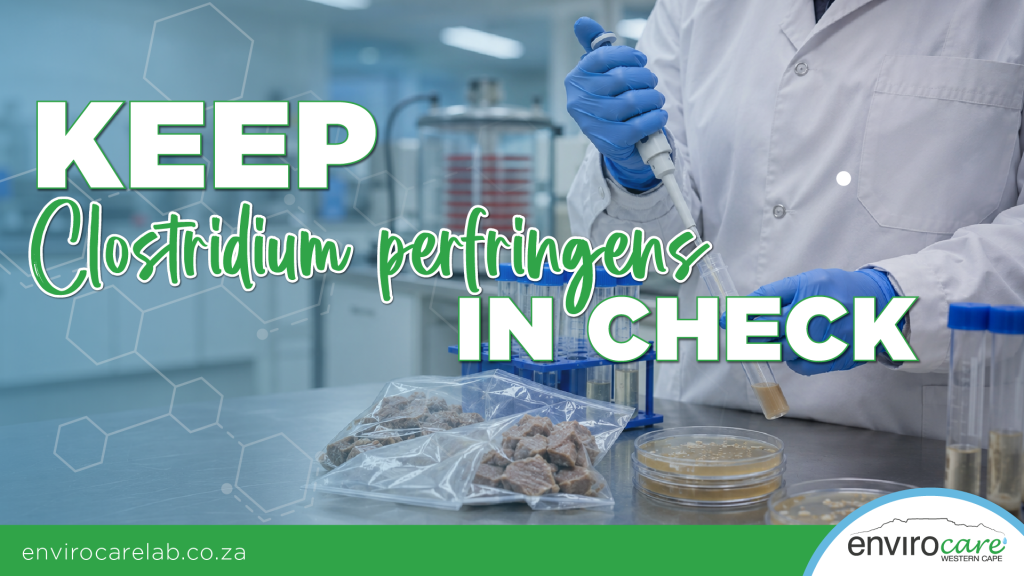
Food manufacturers face ongoing challenges in maintaining the microbiological quality and safety of their products. One organism that deserves particular attention is Clostridium perfringens, a spore-forming bacterium associated with foodborne illness, particularly in cooked foods that have been improperly cooled or stored.
Because its spores can survive certain cooking conditions and subsequently germinate when temperatures are favourable, understanding the risks associated with C. perfringens is important for food manufacturers, processors and food service operators.
Clostridium perfringens testing in food provides valuable microbiological information that can help manufacturers investigate potential contamination concerns, assess product quality and support their food safety and quality assurance programmes.
What Is Clostridium perfringens?
Clostridium perfringens is a Gram-positive, anaerobic, spore-forming bacterium commonly found in soil, dust, sewage and the intestinal tracts of humans and animals. Its widespread distribution means that it can enter food production processes through raw ingredients and other contamination sources.
One of the organism’s most important characteristics is its ability to form heat-resistant spores. These dormant structures allow it to survive environmental conditions that would otherwise destroy ordinary bacterial cells, including certain cooking processes.
When conditions become favourable, the spores can germinate into active bacterial cells. If food is not cooled, stored or handled appropriately, these cells can multiply rapidly.
Certain strains produce an enterotoxin associated with foodborne illness, making the organism an important consideration in food microbiological testing.
How Does Clostridium perfringens Contaminate Food?
Clostridium perfringens may be introduced into food through contaminated raw ingredients, soil, dust or contact with contaminated materials.
However, the conditions following cooking are particularly important when considering the growth of this organism.
Although cooking can destroy many vegetative bacterial cells, some spores may survive. If cooked food is subsequently cooled too slowly or held at unsuitable temperatures, surviving spores can germinate and the bacteria can multiply.
Factors that may encourage bacterial growth include:
- Slow cooling of cooked food.
- Inadequate temperature control during hot holding.
- Improper refrigeration and storage.
- Large quantities of food being prepared in advance.
- Extended periods at temperatures that support bacterial growth.
- Inadequate reheating practices.
These factors highlight why appropriate time and temperature controls are essential throughout food preparation, storage and distribution.
Which Foods Are Commonly Associated with Clostridium perfringens?
Although C. perfringens can occur in various food products, foodborne illness is particularly associated with cooked foods that are prepared in large quantities and subsequently held at unsuitable temperatures.
Products commonly associated with this organism include:
- Cooked and processed meats.
- Poultry products.
- Gravies and sauces.
- Stews and casseroles.
- Ready-to-eat meals.
- Prepared foods intended for catering and institutional food service.
The risk is not limited to a particular food category. The handling, processing, cooling and storage conditions of a product all influence whether the organism can multiply to concerning levels.
For food manufacturers, understanding the microbiological risks associated with their specific products is an important part of product quality and safety management.
Why Is Clostridium perfringens Testing Important?
Microbiological testing provides manufacturers with information about the organisms present in their food products and helps support informed quality assurance decisions.
Clostridium perfringens enumeration can be particularly useful when assessing products where this organism has been identified as a relevant microbiological hazard.
Testing may support:
Finished Product Verification
Analysing finished food products provides information about the microbiological levels of the organism in the submitted sample. Results can be evaluated against applicable product specifications and relevant microbiological criteria.
Microbiological Investigations
Where a food product presents a microbiological concern, testing can contribute to an investigation into potential contamination or inadequate process control.
Process Verification
Testing can form part of a broader verification programme to assess whether relevant manufacturing and handling controls are achieving the intended microbiological outcomes.
Quality Assurance Programmes
Including relevant microbiological parameters in a product monitoring programme helps manufacturers gather information about the microbiological quality of their products over time.
Importantly, laboratory testing complements good manufacturing practices and appropriate temperature control. It does not replace the need for effective preventive measures throughout production.
When Should Food Manufacturers Consider Clostridium perfringens Testing?
The decision to test should be guided by the nature of the product, its manufacturing process, intended use, potential microbiological hazards and applicable customer or regulatory requirements.
Manufacturers may consider C. perfringens testing in situations such as:
- When developing or introducing new cooked food products.
- Following changes to production or cooling procedures.
- During investigations into microbiological quality concerns.
- When verifying finished products against established specifications.
- As part of a risk-based product monitoring programme.
- When requested by customers or required by relevant product criteria.
Selecting appropriate microbiological parameters is important. Not every food product requires the same testing programme, and the relevance of C. perfringens should be assessed according to the product’s individual risk profile.
What Does Clostridium perfringens Enumeration Tell You?
Clostridium perfringens enumeration is a quantitative microbiological analysis used to determine the number of viable organisms present in a submitted sample.
Unlike a detection test, which generally establishes whether an organism has been detected under the conditions of the method, enumeration provides an indication of the bacterial concentration in the tested sample.
Results are generally expressed as colony-forming units per gram (CFU/g), depending on the applicable analytical method and sample type.
These results can help food manufacturers:
- Assess the microbiological levels of C. perfringens in submitted products.
- Compare findings against applicable microbiological specifications.
- Investigate potential deviations from expected product quality.
- Support decisions relating to product and process verification.
It is important to remember that an enumeration result represents the tested sample at the time of analysis. It does not independently establish whether a product is safe, determine the presence of toxin or identify the source of contamination.
Results should always be interpreted alongside the product’s characteristics, manufacturing history, applicable microbiological criteria and other relevant quality assurance information.
Clostridium perfringens Testing at Envirocare Laboratory
At Envirocare Laboratory, we provide microbiological testing services to support food manufacturers in assessing the microbiological quality of their products.
Our microbiology laboratory offers Clostridium perfringens enumeration as part of its range of microbiological analyses for consumable products.
With ISO/IEC 17025-accredited microbiological testing capabilities, we assist businesses across various industries with reliable laboratory analysis and technical support.
Whether you are investigating a microbiological concern, verifying finished products or reviewing your existing testing requirements, our team can assist with selecting relevant analyses for your samples.
For information about Clostridium perfringens testing, sample submission requirements and applicable testing methods, contact our laboratory.
Contact Envirocare Laboratory
Envirocare Laboratory – Potchefstroom
Email: info@envirocarelab.co.za
Telephone: +27 18 294 4283
Website: www.envirocarelab.co.za
Envirocare Western Cape Laboratory
Email: info_westerncape@envirocarelab.co.za
Telephone: +27 82 343 9579 / +27 81 834 7198
Website: www.envirocarelab.co.za
Your Partner in Compliance Success.
References
- Centers for Disease Control and Prevention (CDC) (2026) About C. perfringens food poisoning. Available at: https://www.cdc.gov/clostridium-perfringens/about/index.html
- Centers for Disease Control and Prevention (CDC) (2026) Preventing C. perfringens food poisoning. Available at: https://www.cdc.gov/clostridium-perfringens/prevention/index.html
- National Institute for Communicable Diseases (NICD) (2008) Foodborne disease outbreaks: Guidelines for investigation and control. Available at: https://www.nicd.ac.za/uploads/2018/05/Foodborne_Disease_Outbreaks_Guidelines_for_Investigation_and_Control.pdf
- United States Food and Drug Administration (FDA) (2012) Bad Bug Book: Foodborne Pathogenic Microorganisms and Natural Toxins Handbook. 2nd ed. Available at: https://www.fda.gov/files/food/published/Bad-Bug-Book-2nd-Edition-%28PDF%29.pdf
