


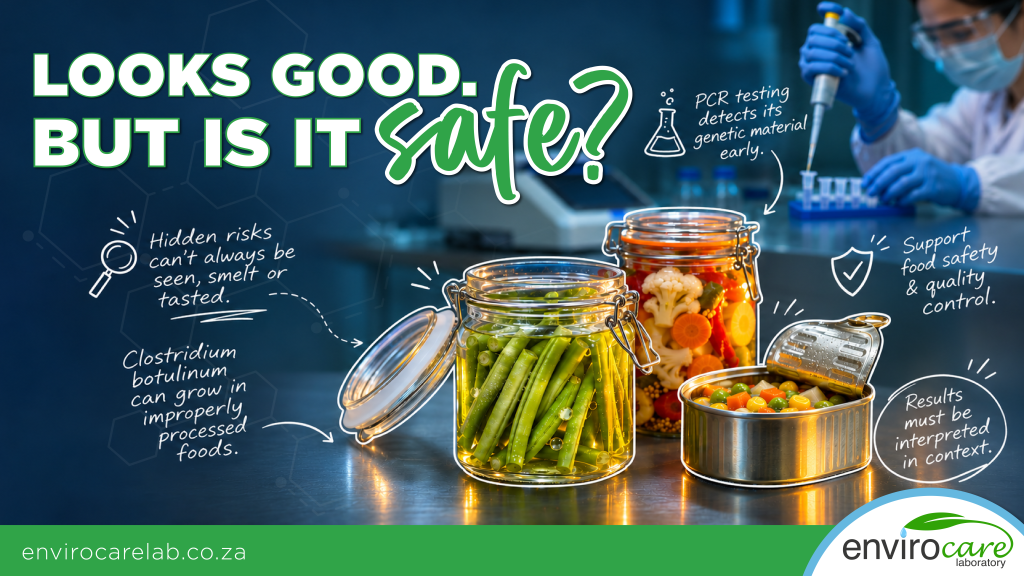
Meat processing, preservation and packaging all play an important role in maintaining food safety and extending product shelf life. However, certain processing and storage conditions can create an environment in which specific foodborne microorganisms may become a concern.
One microorganism that requires particular attention is Clostridium botulinum, a spore-forming bacterium capable of producing botulinum neurotoxins under suitable conditions. These toxins cause botulism, a rare but potentially life-threatening illness that affects the nervous system.
For meat producers, food manufacturers and processors, understanding the potential risks associated with Clostridium botulinum is important when developing products, selecting preservation methods and establishing appropriate microbiological controls.
Specialised PCR testing can also assist food businesses when investigating the potential presence of this microorganism in meat and other food products.
What is Clostridium botulinum?
Clostridium botulinum is an anaerobic, spore-forming bacterium. It is widely distributed in the environment and can be found in soil, water and sediments.
Its spores are highly resistant to environmental conditions and can survive processes that would destroy many ordinary bacterial cells.
Under favourable conditions, the spores can germinate, allowing the bacteria to multiply and potentially produce botulinum neurotoxins.
These toxins interfere with communication between nerves and muscles. Botulism can cause symptoms such as blurred vision, difficulty swallowing, muscle weakness and paralysis. In severe cases, respiratory failure can occur.
Importantly, the presence of C. botulinum spores or bacterial genetic material does not automatically mean that botulinum toxin is present in a food product. Specific conditions are required for bacterial growth and toxin production.
Clostridium botulinum in Meat Products
Meat products require careful consideration when assessing potential microbiological hazards, particularly where preservation methods, packaging and storage conditions may create favourable conditions for anaerobic bacteria.
Raw meat may become contaminated with C. botulinum spores through environmental sources during primary production and processing.
While the presence of spores does not necessarily indicate a food safety problem, certain meat products and processing methods may require specific controls to prevent bacterial growth and toxin production.
Meat products that may warrant consideration include:
1. Vacuum-packed meat
Vacuum packaging is widely used in the meat industry to extend shelf life, reduce oxidation and maintain product quality.
However, removing oxygen from packaging creates a reduced-oxygen environment. This can be favourable to anaerobic microorganisms, including certain strains of C. botulinum, if other growth-controlling factors are inadequate.
Temperature management, product formulation and validated shelf-life controls are particularly important when manufacturing and storing vacuum-packed meat products.
2. Processed and cured meat products
Curing and preservation methods are commonly used in the production of sausages, bacon, ham and other processed meat products.
Ingredients such as salt, nitrite and other curing agents can contribute to controlling microbial growth when used correctly as part of a validated formulation and process.
However, the effectiveness of these controls depends on factors such as ingredient concentrations, product composition, processing conditions and storage temperatures.
3. Ready-to-eat meat products
Ready-to-eat meat products may undergo various processing and packaging treatments to extend shelf life and maintain product quality.
Products stored under reduced-oxygen conditions or with extended refrigerated shelf lives require appropriate consideration of potential microbiological hazards.
Food manufacturers should ensure that preservation methods and storage conditions are suitable for the specific product.
4. Canned meat products
Canned meat products require carefully controlled thermal processing to ensure that bacterial spores are adequately addressed.
Low-acid canned foods are particularly important in relation to C. botulinum, as inadequate processing may allow spores to survive and subsequently germinate under favourable storage conditions.
Commercial thermal processing must therefore be validated according to the product formulation, packaging and processing requirements.
Other Food Products That May Require Clostridium botulinum Risk Assessment
Although meat products are an important consideration, C. botulinum is not limited to the meat industry.
Other food categories that may require appropriate microbiological risk assessment include:
- Fish and seafood: Certain preserved, fermented, smoked and vacuum-packed fish products may present a risk depending on their processing and storage conditions.
- Canned vegetables: Low-acid vegetables require appropriate thermal processing to control bacterial spores.
- Fermented foods: Incorrect fermentation conditions may fail to provide the acidity or other controls needed to inhibit bacterial growth.
- Garlic and herbs in oil: Improperly prepared and stored products may create low-oxygen conditions favourable to bacterial growth.
The risk associated with any food product depends on several interacting factors, including its formulation, processing method, packaging, storage temperature and intended shelf life.
What Conditions Allow Clostridium botulinum to Grow?
Understanding the environmental conditions that influence C. botulinum growth is important when developing and manufacturing meat and other food products.
Several factors influence whether the bacterium can grow and produce toxin.
Oxygen availability
C. botulinum is anaerobic, meaning it can grow in environments where oxygen is absent or limited. This makes reduced-oxygen packaging an important consideration in food safety assessments.
pH and acidity
Acidity plays an important role in controlling bacterial growth. A pH of 4.6 or below is an established threshold for preventing the growth and toxin production of proteolytic C. botulinum in foods, although other factors and applicable regulatory requirements must also be considered.
Temperature
Storage temperature influences bacterial growth. Certain non-proteolytic strains of C. botulinum can grow at refrigeration temperatures, which makes appropriate temperature management essential for some chilled, reduced-oxygen packaged products.
Water activity
Water activity refers to the amount of water available for microbial growth. Reducing available moisture can help inhibit bacterial growth, depending on the organism and product characteristics.
Salt and preservatives
Salt, nitrites and other preservation ingredients can contribute to controlling bacterial growth. Their effectiveness depends on the concentrations used and how they interact with other product characteristics.
These factors should be assessed together rather than individually. A food product’s safety depends on the combined effects of its formulation, processing, packaging and storage conditions.
The Importance of Microbiological Testing in Meat and Food Production
Food manufacturers and meat processors need to understand which microbiological hazards are relevant to their products and manufacturing processes.
Microbiological testing can provide valuable information when investigating specific contamination concerns or assessing potential hazards identified during a product risk assessment.
The choice of testing method depends on the microorganism being investigated, the food matrix and the purpose of the analysis.
For suspected C. botulinum concerns, specialised molecular testing provides an option for detecting targeted genetic material associated with the organism.
Clostridium botulinum PCR Testing in Food Products
Polymerase Chain Reaction (PCR) is a molecular testing technique used to detect specific genetic sequences in a sample.
Specialised PCR assays can target genetic material associated with C. botulinum, including genes linked to botulinum neurotoxin production.
At Envirocare Laboratory, PCR testing for Clostridium botulinum is available for food products, including meat products.
This testing can assist food manufacturers, meat processors and quality assurance teams when investigating potential microbiological contamination and assessing specific food safety concerns.
Does a Positive PCR Result Mean Botulinum Toxin Is Present?
It is important to distinguish between detecting C. botulinum genetic material and detecting botulinum neurotoxin itself.
PCR testing detects targeted DNA sequences associated with the organism or its toxin-producing potential. A positive PCR result does not automatically confirm that the bacteria are actively producing toxin or that botulinum neurotoxin is present in the food product.
Toxin detection requires a separate toxin-specific analytical method.
Laboratory results should therefore be interpreted alongside the product’s formulation, processing conditions, packaging, storage history and overall food safety assessment.
When Should Food Manufacturers Consider Clostridium botulinum PCR Testing?
Targeted PCR testing may be relevant in several food manufacturing and processing situations, including:
- Assessing specific microbiological hazards associated with meat products.
- Investigating concerns involving vacuum-packed or reduced-oxygen packaged foods.
- Reviewing potential microbiological risks in preserved and processed products.
- Investigating suspected contamination of food products.
- Supporting food safety assessments where C. botulinum has been identified as a relevant hazard.
Testing should form part of a broader food safety approach and does not replace validated processing procedures, appropriate preservation methods, refrigeration or good manufacturing practices.
Supporting Food Safety Through Appropriate Laboratory Testing
Understanding the potential risks associated with Clostridium botulinum is particularly important for food businesses working with meat products, vacuum packaging and other preservation methods.
By considering product formulation, processing, packaging and storage conditions, food manufacturers can establish appropriate controls to manage microbiological risks.
Where C. botulinum has been identified as a potential hazard, specialised PCR testing can provide additional information to support food safety investigations.
Need Clostridium botulinum PCR Testing for Your Meat or Food Products?
Envirocare Laboratory offers PCR testing for Clostridium botulinum in food products, including meat products.
Our laboratory assists food manufacturers, meat processors and quality assurance professionals with specialised molecular testing to support their microbiological testing requirements.
Contact Envirocare Laboratory:
Potchefstroom Laboratory
6 Du Plooy Street, Potchefstroom, 2531
Telephone: +27 18 294 4283
Cell: +27 71 353 5740
Email: info@envirocarelab.co.za
Website: https://envirocarelab.co.za
Envirocare Laboratory – Your Partner in Compliance Success.
References
- World Health Organization (WHO). (2023). Botulism. Available at: https://www.who.int/news-room/fact-sheets/detail/botulism (Accessed: 30 October 2026).
- Food Standards Australia New Zealand (FSANZ). (2025). Clostridium botulinum in food. Available at: https://www.foodstandards.gov.au/consumer/prevention-of-foodborne-illness/bacteria-foodborne-illness/clostridium-botulinum (Accessed: 30 October 2026).
- International Organization for Standardization (ISO). (2013). ISO/TS 17919:2013 – Microbiology of the food chain: Polymerase chain reaction (PCR) for the detection of food-borne pathogens – Detection of botulinum type A, B, E and F neurotoxin-producing clostridia. Geneva: ISO. Available at: https://www.iso.org/standard/61010.html.
- Food Standards Agency (FSA). (2020). The safety and shelf-life of vacuum and modified atmosphere packed chilled foods with respect to non-proteolytic Clostridium botulinum. Available at: https://www.food.gov.uk/sites/default/files/media/document/the-safety-and-shelf-life-of-vacuum-and-modified-atmosphere-packed-chilled-foods-with-respect-to-non-proteolytic-clostridium-botulinum_0.pdf.
- European Centre for Disease Prevention and Control (ECDC). Factsheet for health professionals about botulism. Available at: https://www.ecdc.europa.eu/en/botulism/facts.
