

Legionella is a waterborne bacterium that can occur in natural and man-made water systems. Certain conditions can support its growth, making systems such as cooling towers, industrial water installations and building water networks potential sources of contamination.
Exposure can occur when contaminated water is dispersed into fine airborne droplets (aerosols) that are inhaled. This may result in Legionnaires’ disease, a potentially serious form of pneumonia.
For organisations responsible for commercial, industrial and healthcare water systems, Legionella testing provides important laboratory information about the presence of the bacterium in water samples.
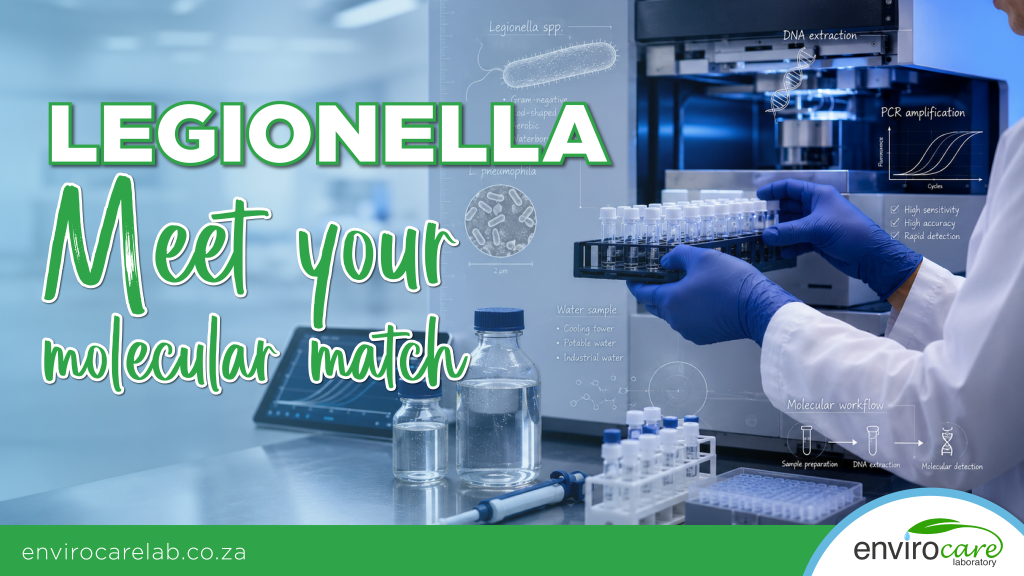
Envirocare Laboratory offers molecular Legionella testing in South Africa using Chemagic® automated nucleic acid extraction technology. With an approximately 48-hour turnaround time from sample receipt, our service helps clients obtain timely laboratory results to support their water-quality monitoring requirements.
What Is Legionella and Why Is It a Concern?
Legionella is a genus of bacteria naturally associated with freshwater environments, including rivers, lakes and streams. Although it may occur naturally in low numbers, it can also be present in artificial water systems where environmental conditions favour its persistence and multiplication.
The bacterium is particularly relevant to water systems that can produce aerosols. When contaminated water is dispersed into small airborne droplets, people may inhale these droplets and become exposed to Legionella.
Two illnesses are associated with Legionella exposure:
- Legionnaires’ disease: A potentially severe form of pneumonia that can require hospitalisation.
- Pontiac fever: A milder, flu-like illness that generally resolves without developing into pneumonia.
Because Legionella cannot be reliably identified through the appearance, smell or taste of water, laboratory analysis is necessary when investigating its presence.
Which Water Systems May Require Legionella Testing?
Legionella may be associated with various man-made water systems, particularly those involving water storage, circulation, heating, cooling or aerosol generation.
Water systems that may require consideration for Legionella testing include:
- Cooling towers and evaporative condensers.
- Hot and cold building water systems.
- Industrial and manufacturing water installations.
- Hospital and healthcare facility water systems.
- Hotels and accommodation establishments.
- Spa pools and hydrotherapy facilities.
- Decorative fountains and water features.
- Commercial buildings and large facilities.
For these systems, laboratory testing can provide useful information about the microbiological condition of submitted water samples.
The appropriate sampling locations and testing frequency should be determined according to the individual system, its intended use and applicable monitoring requirements.
Why Is Legionella Water Testing Important?
Legionella testing provides laboratory evidence that can help organisations investigate potential contamination and make informed decisions about their water systems.
For facility managers, water treatment specialists, consultants and organisations responsible for water quality, testing may form part of routine microbiological monitoring or a specific investigation.
Laboratory analysis may be required for several reasons:
Routine microbiological monitoring
Regular testing can provide information about the microbiological condition of relevant water systems and help identify changes that may require further investigation.
Investigation of potential contamination
Where contamination is suspected or an unexpected result has been obtained, targeted laboratory analysis can provide additional information.
Post-treatment verification
Testing may be requested following cleaning, disinfection or other corrective measures to assess the submitted water sample after treatment.
Water-quality documentation
Laboratory reports provide documented analytical results that can support internal monitoring records, audits and water-quality assessments.
It is important to remember that laboratory results relate to the samples submitted and the conditions at the time of sampling. They should be interpreted alongside the relevant sampling information and the facility’s wider water-quality requirements.
Traditional Culture Testing vs Molecular Legionella Testing
Two laboratory approaches used for Legionella analysis are culture-based testing and molecular detection. Although both can be used to investigate Legionella, they provide different types of information.
Traditional culture testing involves growing viable bacteria under controlled laboratory conditions. It is an established approach for Legionella analysis and can allow bacterial isolates to be recovered for further investigation.
Molecular testing detects genetic material (DNA) associated with the target organism. Rather than waiting for bacteria to grow, molecular analysis identifies the target genetic material, allowing laboratory results to be provided more rapidly.
| Culture-based testing | Molecular testing |
|---|---|
| Detects viable bacteria capable of growing under the test conditions | Detects target bacterial DNA |
| Requires incubation and bacterial growth | Does not require bacterial cultivation |
| Typically requires several days or longer | Can provide faster results |
| Can provide isolates for further investigation | Provides rapid molecular detection |
| Useful when viable bacterial recovery is required | Useful when timely molecular information is required |
The choice of method depends on the purpose of the investigation, applicable requirements and the information needed by the client.
An important distinction: A positive molecular result indicates that the target DNA has been detected. It does not, on its own, confirm that viable bacteria are present or establish their ability to multiply. Molecular detection and culture-based enumeration should therefore not be considered interchangeable.
Rapid Molecular Legionella Testing at Envirocare Laboratory
Envirocare Laboratory uses Chemagic® automated nucleic acid extraction technology as part of its molecular Legionella testing workflow.
The Chemagic® platform uses magnetic-bead-based technology to isolate and purify nucleic acids from samples before downstream molecular analysis.
This automated extraction process supports efficient sample preparation while reducing manual handling during the laboratory workflow.
For clients requiring Legionella testing, Envirocare Laboratory offers:
- Molecular detection of Legionella.
- Automated Chemagic® nucleic acid extraction technology.
- Approximately 48-hour turnaround time from sample receipt.
- Efficient sample preparation.
- Electronic reporting of laboratory results.
- Technical support from experienced laboratory personnel.
The use of automated extraction technology supports the laboratory’s molecular workflow and helps provide clients with timely analytical information.
Why Does a Faster Legionella Testing Turnaround Matter?
When investigating potential water contamination, waiting for laboratory results can delay the next stage of an organisation’s assessment.
Traditional culture-based methods generally require longer incubation periods, whereas molecular testing can provide results within a shorter timeframe.
Envirocare Laboratory’s approximately 48-hour turnaround time from sample receipt allows clients to obtain laboratory information sooner, supporting:
- Routine water-quality monitoring.
- Follow-up investigations.
- Assessment following cleaning and disinfection.
- Review of corrective measures.
- Timely operational decision-making.
A faster turnaround does not replace the need for appropriate sampling, interpretation or follow-up. It provides clients with laboratory information sooner so that appropriate decisions can be considered.
When Should You Consider Legionella Testing?
The timing and frequency of Legionella testing depend on the type of water system, its use and the relevant monitoring requirements.
Testing may be considered:
- As part of an established microbiological monitoring programme.
- When investigating suspected Legionella contamination.
- Following cleaning or disinfection activities where verification is required.
- After corrective measures have been implemented.
- When additional laboratory information is required following an unexpected result.
- When requested as part of a facility’s water-quality assessment.
The selection of sampling points and testing intervals should be based on the individual water system and relevant technical guidance.
Why Choose Envirocare Laboratory for Legionella Testing?
Choosing an appropriate laboratory is an important part of obtaining useful and reliable water-quality information.
Envirocare Laboratory combines molecular testing capabilities with automated sample preparation technology and experienced scientific personnel to support clients requiring Legionella analysis.
Our service offers:
- Molecular Legionella testing.
- Chemagic® automated nucleic acid extraction technology.
- Approximately 48-hour turnaround time from sample receipt.
- Electronic laboratory reporting.
- Professional technical support.
- Service for commercial, industrial and healthcare clients.
Whether you require testing as part of routine monitoring or to investigate a specific water-quality concern, our team can assist with your laboratory testing requirements.
Contact Envirocare Laboratory for Legionella Testing
Reliable laboratory analysis is an important part of informed water-quality assessment.
Envirocare Laboratory provides molecular Legionella testing to support organisations across South Africa. With automated Chemagic® extraction technology and an approximately 48-hour turnaround time from sample receipt, we help clients obtain timely laboratory information for their water-quality monitoring activities.
Contact Envirocare Laboratory to discuss your Legionella testing requirements.
Envirocare Laboratory – Your Partner in Compliance Success.
Contact Details
Envirocare Laboratory – Potchefstroom
Telephone: +27 18 294 4283
Mobile: +27 71 353 5740
Email: info@envirocarelab.co.za
Website: https://envirocarelab.co.za
References
- World Health Organization (WHO). 2007. Legionella and the Prevention of Legionellosis. Geneva: World Health Organization.
- Centers for Disease Control and Prevention (CDC). Legionella (Legionnaires’ Disease and Pontiac Fever).
- International Organization for Standardization (ISO). 2017. ISO 11731:2017 Water Quality – Enumeration of Legionella.
- European Centre for Disease Prevention and Control (ECDC). Legionnaires’ Disease: Surveillance and Prevention.
- Revvity. Chemagic® Automated Nucleic Acid Extraction Technology.
