

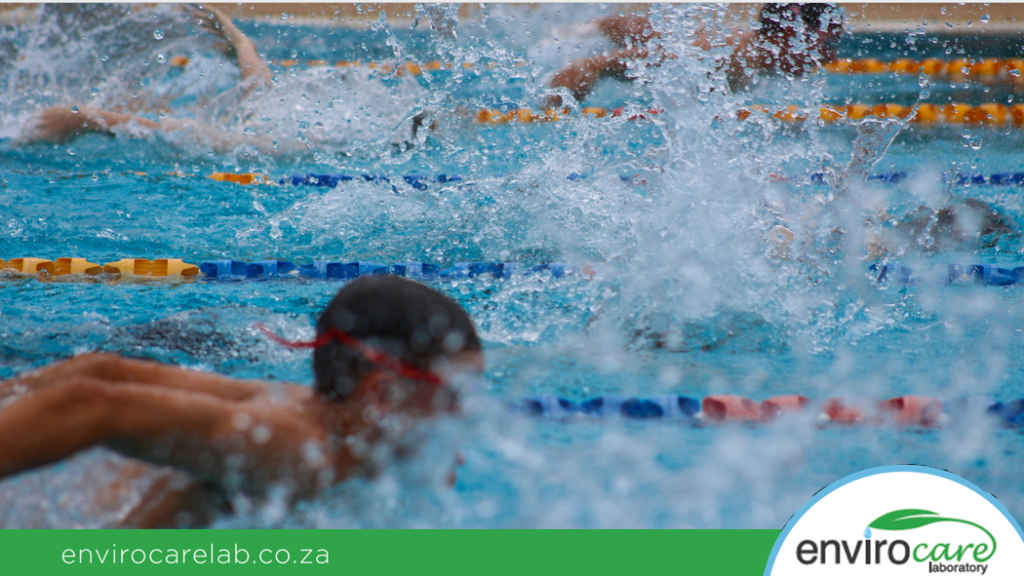
Maintaining clean, hygienic swimming pool water involves far more than achieving crystal-clear water. Whether you operate a public swimming pool, school, hotel, gym, holiday resort, spa, apartment complex, or recreational facility, regular swimming pool water testing is essential for protecting public health and complying with South African regulations.
Poorly maintained pool water can harbour harmful microorganisms, contribute to disease outbreaks, damage equipment, and expose facility operators to legal and reputational risks. Routine microbiological and chemical testing helps ensure that swimming pools remain safe, compliant, and enjoyable for all users.
Why Swimming Pool Water Testing Matters
Swimming pools are used by hundreds—or even thousands—of people throughout the year. Every swimmer introduces microorganisms, organic matter, cosmetics, sunscreen, and other contaminants into the water. Without proper treatment and monitoring, these contaminants can quickly reduce water quality.
Regular laboratory testing helps:
- Protect swimmers from waterborne diseases.
- Verify that disinfection systems are working effectively.
- Detect contamination before it becomes a health risk.
- Demonstrate compliance with South African health regulations.
- Reduce liability for facility owners and managers.
- Maintain water clarity and extend the lifespan of pool equipment.
Routine testing should form part of every pool’s preventative maintenance programme rather than being carried out only after problems occur.
South African Regulations for Swimming Pool Water Quality
Swimming pool water quality in South Africa is governed primarily by the National Health Act (Act No. 61 of 2003) and the Norms and Standards for Environmental Health Services in South Africa, published by the National Department of Health.
These regulations require that:
- Water used in swimming pools and spa baths must originate from an approved water source.
- Pool operators must routinely monitor water quality.
- Records of testing must be maintained for inspection.
- Laboratory analysis should be performed by a SANAS-accredited or appropriately approved laboratory.
- The Total Viable Count (TVC) must not exceed 100 organisms per mL.
- Escherichia coli (E. coli) and other faecal indicator organisms must be absent in 100 mL of water.
- Pool water pH should be maintained between 7.2 and 7.8.
- Free available chlorine should remain between 0.5 mg/L and 3.0 mg/L.
These requirements provide the minimum standard for maintaining hygienic swimming pool water and reducing the risk of disease transmission.
Municipal By-Laws Also Apply
Many municipalities have their own Environmental Health or Public Health By-laws that reinforce national legislation.
Examples include:
- City of Johannesburg Public Health By-law (2018) – requires swimming pools to be maintained in a clean and hygienic condition and water quality to comply with national health standards.
- Buffalo City Metropolitan Municipality Environmental Health By-law (2010) – specifies acceptable limits for chlorine, pH, bacterial counts and the absence of E. coli.
Pool owners should always consult their local municipality, as additional requirements may apply depending on the location and type of facility.
Who Should Test Their Swimming Pool Water?
Regular laboratory testing is recommended for:
- Public swimming pools
- Municipal swimming pools
- Hotels and guest houses
- Holiday resorts
- Schools and universities
- Sports clubs
- Gyms and fitness centres
- Apartment complexes
- Residential estates
- Water parks
- Spa pools and heated pools
- Rehabilitation and hydrotherapy facilities
Any facility that provides public access to a swimming pool has a responsibility to ensure water remains safe throughout the year.
What Should Be Tested?
A comprehensive swimming pool testing programme includes both microbiological and chemical analysis.
Microbiological Testing
Microbiological testing identifies potentially harmful bacteria and provides an indication of the overall hygienic condition of the water.
Recommended tests include:
| Parameter | Why It Matters |
|---|---|
| Total Viable Count (TVC) | Indicates the overall bacterial load in the pool. |
| Total Coliforms | General indicator of water hygiene. |
| Escherichia coli (E. coli) | Indicates faecal contamination and should be absent. |
| Pseudomonas aeruginosa | Can cause ear infections, skin rashes and hot tub folliculitis. |
| Staphylococcus aureus | May contribute to skin and wound infections. |
| Yeasts and Moulds | Particularly useful for heated pools and spa facilities. |
Chemical Testing
Chemical balance is equally important for swimmer comfort and effective disinfection.
Recommended parameters include:
| Parameter | Recommended Range or Purpose |
| pH | 7.2–7.8 |
| Free Available Chlorine | 0.5–3.0 mg/L |
| Combined Chlorine | Indicates chloramine formation and reduced disinfectant efficiency. |
| Total Dissolved Solids (TDS) | Measures dissolved contaminants accumulating over time. |
| Turbidity | Should generally remain below 5 NTU. |
| Total Alkalinity | Helps stabilise pH. |
| Calcium Hardness | Reduces corrosion and scaling issues. |
| Cyanuric Acid | Important where stabilised chlorine products are used. |
Testing both microbiological and chemical parameters provides a complete picture of pool water quality.
How Often Should Swimming Pool Water Be Tested?
Testing frequency depends on pool usage, but the following schedule is widely recommended.
Daily Onsite Monitoring
Pool operators should monitor:
- pH
- Free chlorine
- Water temperature
- Visual clarity
These checks are typically performed using calibrated field test kits.
Monthly Laboratory Testing
Laboratory testing should be performed at least monthly for:
- Total Viable Count
- Total Coliforms
- E. coli
- Pseudomonas aeruginosa
- Additional microbiological parameters where appropriate
More frequent testing may be required for high-use public pools or facilities with previous compliance issues.
Additional Testing
Laboratory analysis should also be conducted:
- After major maintenance or repairs.
- Following contamination incidents (such as faecal accidents).
- After flooding or heavy rainfall.
- When unusual odours, cloudiness or algae growth occur.
- Whenever Environmental Health Practitioners request additional sampling.
Common Causes of Failed Swimming Pool Water Tests
Many failed laboratory reports result from preventable operational issues, including:
- Inadequate chlorine dosing.
- Poor filtration performance.
- Incorrect pH control.
- Heavy swimmer loads.
- Biofilm development within pipework.
- Insufficient circulation.
- Contaminated source water.
- Inadequate cleaning of pool surrounds and equipment.
Identifying these issues early helps prevent costly closures and protects swimmer health.
Why Laboratory Testing Is Better Than Pool Test Strips
Many pool operators rely on rapid field test strips for daily monitoring. While these are useful for routine operational checks, they cannot detect harmful bacteria or provide the accuracy needed for regulatory compliance.
Laboratory testing offers several advantages:
- Accredited analytical methods.
- Detection of harmful microorganisms.
- Greater analytical accuracy.
- Independent verification of water quality.
- Compliance documentation for inspections and audits.
- Confidence that both microbiological and chemical standards are being achieved.
Onsite testing and laboratory testing should complement one another rather than replace each other.
Sampling and Record-Keeping
The National Department of Health requires pool operators to maintain accurate records of water quality monitoring.
Good record-keeping should include:
- Daily chlorine and pH readings.
- Laboratory reports.
- Corrective actions taken after failed results.
- Maintenance and cleaning records.
- Calibration records for monitoring equipment.
These records demonstrate due diligence and support compliance during Environmental Health inspections.
Swimming Pool Water Testing with Envirocare Laboratory
Envirocare Laboratory provides comprehensive swimming pool water testing services for public and private facilities throughout South Africa.
Our SANAS-accredited laboratory offers accurate microbiological and chemical analysis to help clients:
- Meet regulatory requirements.
- Monitor swimming pool hygiene.
- Verify disinfection effectiveness.
- Protect public health.
- Maintain confidence in their facilities.
Our experienced team supports schools, municipalities, hotels, resorts, gyms, sports clubs, residential estates, and commercial facilities with reliable laboratory testing and professional technical advice.
Summary of Recommended Testing
| Parameter | Recommended Limit | Typical Frequency | Responsibility |
| pH | 7.2–7.8 | Daily | Pool Operator |
| Free Chlorine | 0.5–3.0 mg/L | Daily | Pool Operator |
| Total Viable Count | ≤100 organisms/mL | Monthly | Laboratory |
| Total Coliforms | Low/Absent | Monthly | Laboratory |
| E. coli | Absent in 100 mL | Monthly | Laboratory |
| Pseudomonas aeruginosa | Absent | Monthly | Laboratory |
| Turbidity | <5 NTU | Monthly | Laboratory |
Protect Swimmers Through Regular Water Testing
Swimming pool water testing is not simply a regulatory requirement—it is an essential part of protecting public health. Consistent monitoring of microbiological and chemical parameters helps prevent disease transmission, maintains water quality, and demonstrates responsible facility management.
By partnering with Envirocare Laboratory, you gain access to reliable SANAS-accredited testing, professional technical support, and accurate results that help ensure your swimming pool remains safe, compliant, and ready for use throughout the year.
Contact Envirocare Laboratory
Email: info@envirocarelab.co.za
Telephone: +27 18 294 4283
Website: https://envirocarelab.co.za/
References
- Department of Health (South Africa). (2019). Norms and Standards for Environmental Health Services in South Africa. National Department of Health.
- Republic of South Africa. (2003). National Health Act (Act No. 61 of 2003).
- City of Johannesburg Metropolitan Municipality. (2018). Public Health By-law.
- Buffalo City Metropolitan Municipality. (2010). Environmental Health By-law.
- South African Bureau of Standards (SABS). (2016). SANS 10134: Safety of Private Swimming Pools.
- South African Bureau of Standards (SABS). (2011). SANS 241: Drinking Water – Quality Requirements.
- Department of Water and Sanitation (South Africa). (2016). Regulations Relating to Compulsory National Standards and Measures to Conserve Water.
