


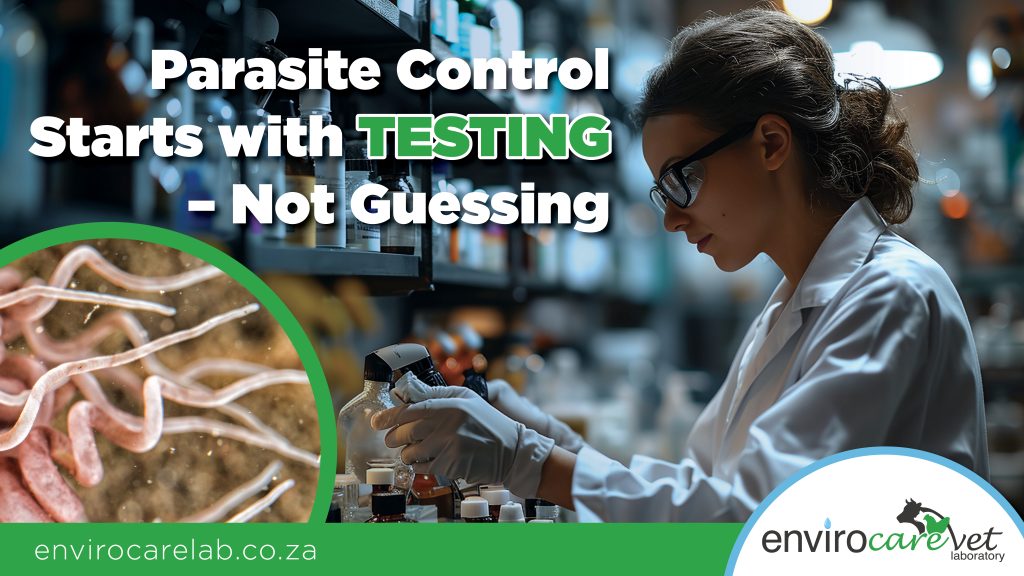
As South Africa’s rainy season approaches in November and December, livestock farmers enter one of the most critical periods for parasite management. Warmer temperatures, increased rainfall, and higher humidity create ideal conditions for gastrointestinal parasites to develop and spread rapidly across grazing pastures.
Without effective monitoring and timely intervention, internal parasites can significantly reduce livestock productivity, increase treatment costs, and compromise animal welfare. One of the most effective tools for managing this risk is Faecal Egg Count (FEC) testing, which enables farmers and veterinarians to make informed parasite control decisions based on scientific evidence rather than routine deworming schedules.
Why the Rainy Season Increases Parasite Risk
During South Africa’s dry winter months, parasite development slows considerably due to low moisture levels on pastures. However, the arrival of spring and summer rainfall dramatically changes grazing conditions.
Parasite eggs passed in faeces hatch into infective larvae that thrive in warm, moist environments. These larvae migrate onto grass where they are consumed by grazing animals, resulting in a rapid increase in parasite burdens.
High worm burdens can lead to:
- Reduced weight gain and growth rates
- Lower milk production
- Poor feed conversion efficiency
- Diarrhoea and digestive disturbances
- Anaemia caused by blood-feeding worms such as Haemonchus contortus
- Bottle jaw (submandibular oedema), particularly in sheep and goats
- Reduced fertility and overall productivity
- Severe infestations that may result in livestock losses if left untreated
Young animals, recently weaned stock, and animals under nutritional or environmental stress are particularly vulnerable during this period.
What Is a Faecal Egg Count (FEC)?
A Faecal Egg Count (FEC) is a laboratory test used to estimate the number of gastrointestinal worm eggs present in an animal’s faeces. Results are typically reported as Eggs Per Gram (EPG) of faeces, providing an indication of the parasite burden within the animal or herd.
Rather than relying on routine calendar-based deworming, FEC testing allows producers to implement evidence-based parasite management programmes that improve treatment outcomes while reducing unnecessary use of anthelmintics.
What Does Eggs Per Gram (EPG) Mean?
EPG measures the concentration of parasite eggs in a faecal sample. While egg counts do not always represent the exact number of adult worms present, they provide an excellent indicator of parasite activity within a herd or flock.
EPG results help veterinarians and farmers:
- Identify animals requiring treatment
- Monitor parasite trends over time
- Evaluate the success of deworming programmes
- Determine whether parasite burdens are increasing before clinical disease develops
- Reduce unnecessary treatments that contribute to drug resistance
Interpretation of EPG values should always consider the animal species, age, production stage, season, and the parasite species identified.
Why Routine Faecal Egg Count Testing Is Important
Regular monitoring offers several important advantages over blanket deworming programmes.
Benefits include:
- Targeted treatment of animals with significant parasite burdens
- Improved timing of deworming before parasite numbers peak
- Reduced development of anthelmintic resistance
- Better herd and flock productivity
- Lower medication costs
- Sustainable long-term parasite control
Routine testing has become an important component of modern integrated parasite management programmes worldwide.
Faecal Egg Count Testing for Sheep, Goats and Cattle
Although the same laboratory techniques are used, parasite management differs between livestock species.
Sheep
Sheep are particularly susceptible to parasites such as Haemonchus contortus (wireworm), especially during warm, wet conditions. Regular FEC testing helps identify animals requiring treatment before clinical signs such as anaemia or bottle jaw develop.
Goats
Goats generally develop weaker immunity to gastrointestinal worms than sheep or cattle, making frequent monitoring especially valuable. Strategic FEC testing helps prevent production losses while reducing unnecessary deworming.
Cattle
Young cattle and calves are most vulnerable to gastrointestinal parasites during their first grazing seasons. Routine monitoring allows farmers to identify rising parasite burdens before growth rates and feed efficiency are affected.
Detecting Anthelmintic Resistance
One of the greatest challenges facing livestock producers is anthelmintic resistance, where parasites become less susceptible to commonly used dewormers.
Frequent blanket treatments accelerate resistance development, making parasite control increasingly difficult.
Faecal Egg Count testing performed before and after treatment enables veterinarians to evaluate whether a dewormer has effectively reduced parasite egg counts. Early detection of resistance allows producers to adjust parasite control strategies before significant production losses occur.
Envirocare’s Advanced Faecal Egg Count Services
At Envirocare Veterinary Laboratory, faecal egg count testing is performed using specialised microscopic techniques that provide high-resolution visualisation of gastrointestinal parasite eggs.
Our experienced laboratory analysts identify and document important parasite groups, including:
- Strongyle-type nematodes
- Haemonchus species
- Coccidia (Eimeria spp.)
- Tapeworm eggs
- Other gastrointestinal parasites where applicable
Our service includes professional interpretation of results, helping veterinarians and livestock producers make informed parasite management decisions based on laboratory evidence rather than assumptions.
When Should Animals Be Tested?
Routine monitoring throughout the year provides the greatest benefit, but testing is especially valuable during seasonal transitions.
Recommended testing periods include:
Before the rainy season (October–November)
- Establish baseline parasite burdens
- Determine whether pre-season treatment is required
During the rainy season (December–February)
- Monitor parasite build-up
- Assess treatment effectiveness
- Identify high-risk groups requiring additional intervention
After the rainy season (March–April)
- Evaluate overall parasite control success
- Inform management decisions for the following season
Additional testing may be recommended for young animals, newly introduced livestock, breeding stock, or animals showing signs of poor performance.
Sample Collection Guidelines
Accurate laboratory results begin with proper sample collection.
For best results:
- Collect fresh faecal samples directly from the rectum or immediately after defecation.
- Place samples into clean, sealed containers.
- Clearly label each sample with the animal identification and collection date.
- Keep samples refrigerated but do not freeze them.
- Deliver samples to the laboratory within 24 hours whenever possible.
Proper sample handling helps preserve parasite eggs and ensures accurate laboratory analysis.
Supporting Animal Health Through Science
Effective parasite management begins with accurate diagnosis. Routine Faecal Egg Count testing provides farmers and veterinarians with the information needed to monitor parasite burdens, evaluate treatment effectiveness, detect anthelmintic resistance, and protect livestock productivity throughout the year.
At Envirocare Veterinary Laboratory, we combine advanced microscopic imaging, accurate laboratory analysis, and expert interpretation to support evidence-based parasite management for cattle, sheep, and goats across South Africa.
Contact Envirocare Laboratory to schedule Faecal Egg Count testing before the summer rains and take a proactive approach to parasite control.
Envirocare Laboratory
Tel: +27 18 294 4283
Email: info@envirocarelab.co.za
Website: https://envirocarelab.co.za/
References
- Bath, G.F. & Van Wyk, J.A. (2009). The FAMACHA® system for managing haemonchosis in sheep and goats. Small Ruminant Research, 76(1–2), 13–17.
- Coles, G.C. et al. (1992). World Association for the Advancement of Veterinary Parasitology (WAAVP): Methods for detection of anthelmintic resistance. Veterinary Parasitology, 44(1–2), 35–44.
- Department of Agriculture, Land Reform and Rural Development (DALRRD). (2022). Livestock Health – Internal Parasite Management in South Africa.
- South African Veterinary Association (SAVA). (2023). Guidelines for Sustainable Internal Parasite Control in Ruminants in South Africa.
- Van Wyk, J.A., Cabaret, J., & Michael, L.M. (2004). Morphological identification of nematode larvae of small ruminants and cattle simplified. Veterinary Parasitology, 119(4), 277–306.
