


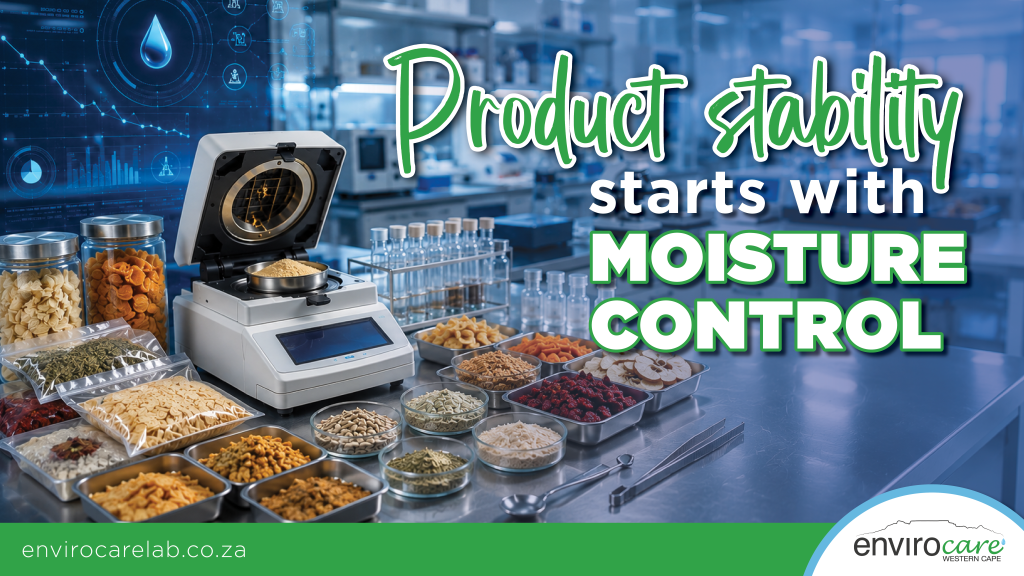
Dehydrated and low-moisture foods play a vital role in today’s food industry, offering longer shelf life, easier transportation, reduced storage costs, and improved product stability. From dried fruits and vegetables to herbs, spices, cereals, snack foods, protein powders, and pet food ingredients, these products depend on one critical quality parameter: accurate moisture content.
During Food Safety Awareness Month, moisture analysis serves as an important reminder that maintaining the correct moisture level is about more than preventing spoilage. It supports consistent product quality, manufacturing efficiency, regulatory compliance, and customer confidence throughout the supply chain.
At Envirocare Laboratory, we provide accurate moisture analysis services for food manufacturers across South Africa from our ISO/IEC 17025-accredited laboratories in Potchefstroom and the Western Cape. Our testing helps manufacturers verify product specifications, support quality assurance programmes, and produce safe, consistent products.
What Is Moisture Analysis?
Moisture analysis measures the amount of water present within a food product. For dehydrated and low-moisture foods, maintaining the correct moisture content is essential because even small changes can influence product quality, processing performance, packaging stability, and shelf life.
Although dehydration significantly reduces the water available for microbial growth, excessive residual moisture can still create conditions that affect product quality during storage and distribution.
Routine laboratory moisture testing allows manufacturers to verify that every production batch consistently meets established quality specifications.
Why Moisture Content Is Critical in Food Manufacturing
Moisture content influences nearly every stage of a product’s lifecycle—from production and packaging to transport and consumer use.
Extending Shelf Life
One of the primary objectives of dehydration is to produce products that remain stable for extended periods. Moisture levels that exceed product specifications may accelerate deterioration, resulting in reduced shelf life, increased product losses, and customer complaints.
Moisture analysis is often performed alongside shelf-life studies to verify that products remain within specification throughout their intended storage period.
Maintaining Product Quality
Excess moisture can alter the physical characteristics of dehydrated foods, resulting in:
- Loss of crispness
- Product caking
- Clumping of powders
- Texture changes
- Reduced free-flowing properties
- Changes in flavour and appearance
Routine moisture testing helps manufacturers maintain consistent product quality across production batches.
Supporting Food Safety
Although many dehydrated foods are considered microbiologically stable, elevated moisture levels may increase the likelihood of microbial survival or growth under favourable conditions.
Routine moisture verification forms an important part of a comprehensive food safety and quality management programme.
Protecting Packaging Performance
Moisture can influence packaging integrity by contributing to condensation, reduced barrier performance, product caking, and shortened storage stability.
Verifying moisture content before packaging helps preserve both the product and its packaging throughout transport and storage.
Improving Manufacturing Consistency
Many dehydrated ingredients are incorporated into larger manufacturing processes where consistent functionality is essential.
Moisture variation can influence:
- Mixing performance
- Powder flowability
- Rehydration characteristics
- Ingredient dosing
- Processing efficiency
- Final product consistency
Routine laboratory testing helps manufacturers identify process variation before it affects production.
Industries That Benefit from Moisture Analysis
Moisture analysis supports quality assurance across a wide range of food manufacturing sectors, including:
- Snack food manufacturing
- Dried fruit and vegetable processing
- Herbs and spice production
- Breakfast cereals
- Grain and flour milling
- Baking ingredients
- Protein powders
- Nutritional supplements
- Instant food products
- Powdered beverages
- Pet food manufacturing
- Animal feed production
Manufacturers producing export products or supplying national retailers often include routine moisture testing within their quality assurance programmes.
Moisture Analysis for Snack Food Manufacturers
Snack products present unique quality challenges because consumers expect consistent texture and freshness.
Routine moisture testing helps manufacturers of:
- Potato crisps
- Extruded snacks
- Crackers
- Biscuits
- Nuts
- Popcorn
- Dried fruit snacks
- Biltong
- Cereal snacks
- Protein snacks
maintain product quality while reducing the risk of texture deterioration, caking, and shortened shelf life.
Supporting Quality Assurance and Export Compliance
Many retailers, food manufacturers, and export markets require analytical verification that products consistently meet defined quality specifications.
Moisture analysis supports:
- Product specification verification
- Quality control programmes
- Supplier verification
- Shelf-life studies
- Customer quality requirements
- Export documentation
- Food safety management systems
- Regulatory compliance
Reliable laboratory results provide manufacturers with documented evidence that products remain within specification before reaching customers.
Why Routine Moisture Monitoring Matters
Moisture content may vary due to several factors, including:
- Raw material variability
- Processing conditions
- Drying efficiency
- Ambient humidity
- Packaging performance
- Storage conditions
- Transportation environments
Routine moisture monitoring enables manufacturers to identify deviations early, implement corrective actions, reduce waste, and improve overall production consistency.
Rather than relying solely on end-product inspections, regular laboratory testing provides valuable data that supports continuous quality improvement.
Moisture Content vs Water Activity
Although closely related, moisture content and water activity measure different aspects of a food product.
Moisture analysis determines the total amount of water present within the product, while water activity measures how much of that water is available to support microbial growth and chemical reactions.
Depending on the product and intended shelf life, manufacturers often use both analyses together to gain a more complete understanding of product stability.
Why Choose Envirocare Laboratory?
Envirocare Laboratory provides accurate moisture analysis services to food manufacturers throughout South Africa.
Our ISO/IEC 17025-accredited laboratories support:
- Moisture content testing
- Food quality assurance programmes
- Shelf-life verification
- Product specification testing
- Manufacturing quality control
- Export readiness
- Food safety compliance
Whether you manufacture dehydrated foods, snack products, powdered ingredients, herbs, spices, cereals, or pet food, our experienced analytical team delivers reliable laboratory results to support informed quality decisions.
Contact Envirocare Laboratory
Potchefstroom Laboratory
☎ +27 18 294 4283
📍 6 Du Plooy Street, Potchefstroom, 2531
Western Cape Laboratory
📧 info_westerncape@envirocarelab.co.za
☎ +27 82 343 9579 | +27 81 834 7198
📍 PTF 18, Three Fountains Estate, R304, Philadelphia, Western Cape, 7304
References
- Barbosa-Cánovas, G. V., Fontana Jr., A. J., Schmidt, S. J., & Labuza, T. P. (2020). Water Activity in Foods: Fundamentals and Applications (2nd ed.). Wiley-Blackwell.
- Beuchat, L. R. (1981). Microbial Stability as Affected by Water Activity. Cereal Foods World, 26(7), 345–349.
- Codex Alimentarius Commission. (2022). General Principles of Food Hygiene (CXC 1-1969). FAO/WHO.
- Fellows, P. J. (2017). Food Processing Technology: Principles and Practice (4th ed.). Woodhead Publishing.
- Food and Agriculture Organization of the United Nations (1990). Manual on Simple Methods of Meat Preservation.
- ICMSF. (2005). Microorganisms in Foods 6: Microbial Ecology of Food Commodities (2nd ed.).
- ISO 6540. Maize — Determination of Moisture Content.
- ISO 712. Cereals and Cereal Products — Determination of Moisture Content.
- Jay, J. M., Loessner, M. J., & Golden, D. A. (2005). Modern Food Microbiology (7th ed.).
- Rahman, M. S. (2009). Food Properties Handbook (2nd ed.).
- U.S. Food and Drug Administration. (2022). Bad Bug Book.
- United States Department of Agriculture. (2024). Food Safety and Inspection Service: Shelf Stability and Moisture Control in Food Products.
