


Antimicrobial resistance (AMR) continues to present major challenges across the clinical, veterinary, food production, pharmaceutical, and environmental sectors. As microorganisms evolve resistance to commonly used antimicrobial agents, accurate laboratory testing becomes increasingly important for guiding treatment decisions, evaluating antimicrobial effectiveness, supporting product development, and monitoring resistance trends.
Antibiotic Susceptibility Testing (AST), Minimum Inhibitory Concentration (MIC) testing, and Antibiogram Analysis are internationally recognised microbiological tools used to evaluate how microorganisms respond to antimicrobial agents. These techniques provide valuable information for clinicians, veterinarians, researchers, food manufacturers, pharmaceutical companies, and environmental professionals seeking scientifically reliable data.
At Envirocare Laboratory, we provide advanced AST, MIC, and Antibiogram Analysis services under an ISO/IEC 17025-accredited quality system. Our methodologies are aligned with internationally recognised Clinical and Laboratory Standards Institute (CLSI) and European Committee on Antimicrobial Susceptibility Testing (EUCAST) standards, ensuring technically sound, traceable, and reliable results.
What is Antibiotic Susceptibility Testing (AST)?
Antibiotic Susceptibility Testing (AST), also referred to as antimicrobial susceptibility testing, is performed to determine how susceptible or resistant a microorganism is to specific antimicrobial agents. AST helps identify effective antimicrobial options while supporting antimicrobial stewardship programmes and resistance monitoring initiatives.
In microbiology, AST plays a critical role in determining whether bacteria are susceptible, intermediate, or resistant to antimicrobial compounds under standardised laboratory conditions. The results provide valuable information for selecting appropriate antimicrobial therapies, evaluating product efficacy, and monitoring changing resistance patterns over time.
At Envirocare Laboratory, AST is performed using validated methodologies under controlled laboratory conditions in accordance with internationally accepted best practices.
Our testing supports applications including:
- Clinical microbiology
- Veterinary diagnostics
- Food safety investigations
- Environmental monitoring
- Water microbiology
- Pharmaceutical and product development
- Research and validation studies
Our approach focuses on quality, traceability, reproducibility, and internationally recognised laboratory standards.
AST Methods Used in Microbiology
Several internationally recognised methods are available for performing Antibiotic Susceptibility Testing. The selected method depends on the microorganism, antimicrobial agent, testing objective, and applicable international guideline.
Common AST methodologies include:
- Disc diffusion (Kirby-Bauer method)
- Broth microdilution
- Agar dilution
- Gradient diffusion methods
- Automated susceptibility testing systems where applicable
All testing is performed using validated laboratory procedures supported by appropriate quality controls, calibrated equipment, and recognised reference strains.
Understanding Minimum Inhibitory Concentration (MIC) Testing
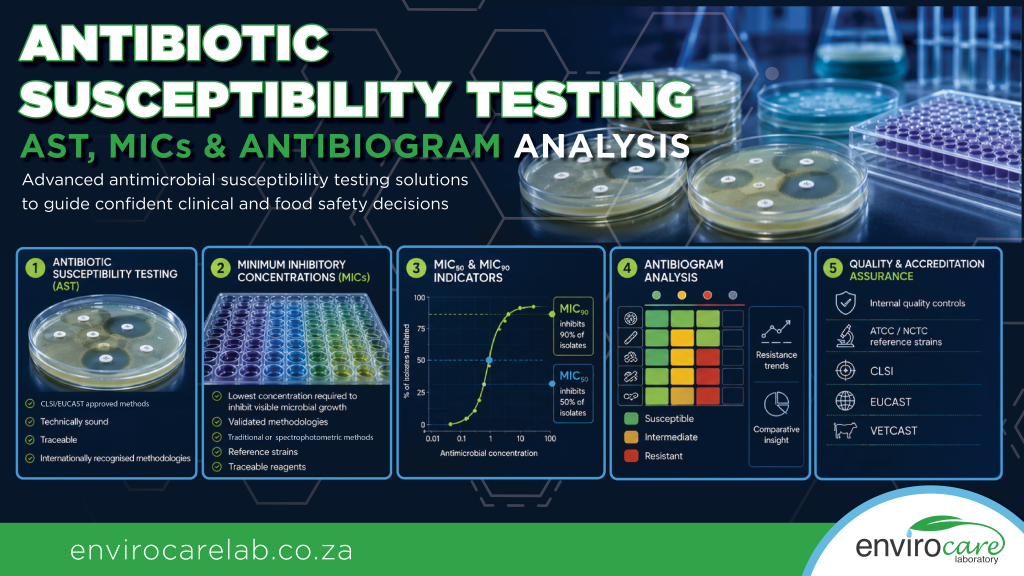
Minimum Inhibitory Concentration (MIC) testing determines the lowest concentration of an antimicrobial agent required to inhibit visible microbial growth under defined laboratory conditions.
Unlike qualitative susceptibility testing, MIC testing provides quantitative information regarding antimicrobial activity, allowing more detailed comparisons between antimicrobial agents and microorganisms.
MIC testing is widely used for:
- Antimicrobial effectiveness evaluation
- Product development studies
- Comparative antimicrobial analysis
- Resistance trend investigations
- Pharmaceutical research
- Food safety validation studies
- Research and development programmes
At Envirocare Laboratory, MIC determinations are:
- Performed using standardised validated methodologies
- Conducted using traditional or spectrophotometric methods where appropriate
- Verified using suitable control and reference strains
- Supported by calibrated equipment and traceable reagents
- Interpreted according to recognised CLSI and EUCAST guidance where applicable
Understanding MIC₅₀ and MIC₉₀
MIC data frequently includes important statistical indicators that assist with interpreting antimicrobial performance across microbial populations.
These include:
MIC₅₀ – the antimicrobial concentration inhibiting 50% of isolates tested.
MIC₉₀ – the antimicrobial concentration inhibiting 90% of isolates tested.
These indicators are particularly valuable during antimicrobial comparisons, surveillance studies, product evaluations, and resistance investigations, providing a broader understanding of antimicrobial performance within microbial populations.
What is an Antibiogram?
An antibiogram is a structured summary of antimicrobial susceptibility results generated from a defined collection of microbial isolates tested against multiple antimicrobial agents.
Rather than evaluating a single isolate, an antibiogram provides an overview of susceptibility patterns across a population of microorganisms, making it an important tool for monitoring antimicrobial resistance trends.
Antibiograms provide valuable insight into:
- Susceptibility trends
- Emerging resistance patterns
- Comparative antimicrobial effectiveness
- Population-level resistance monitoring
- Antimicrobial stewardship programmes
- Research and surveillance activities
Our antibiogram reports classify isolates according to internationally recognised interpretive criteria as:
- Susceptible (S)
- Intermediate (I)
- Resistant (R)
These analyses support evidence-based decision-making across clinical, veterinary, food production, pharmaceutical, environmental, and research sectors.
Why AST and MIC Testing Matter
The global increase in antimicrobial resistance has highlighted the importance of accurate susceptibility testing. Reliable AST and MIC data allow laboratories and organisations to make informed scientific decisions while supporting regulatory compliance, product validation, and public health initiatives.
Accurate susceptibility testing assists with:
- Identifying effective antimicrobial agents
- Monitoring resistance trends over time
- Supporting antimicrobial stewardship
- Validating antimicrobial products
- Evaluating disinfectants and preservatives
- Supporting research and development
- Improving food safety and environmental monitoring programmes
Quality Assurance and Accreditation
All AST and MIC data generated by Envirocare Laboratory is supported by a robust ISO/IEC 17025 quality framework designed to ensure technical competence, accuracy, and traceability.
Our quality systems include:
- Internal quality controls
- Recognised reference strains including ATCC and NCTC
- Traceable laboratory systems
- Calibrated laboratory instrumentation
- CLSI and EUCAST-aligned methodologies
Where applicable, testing may also incorporate VETCAST guidance for veterinary antimicrobial susceptibility interpretation.
Why Choose Envirocare Laboratory?
When antimicrobial accuracy, traceability, and regulatory alignment matter, Envirocare Laboratory provides dependable laboratory solutions supported by internationally recognised quality systems.
Our laboratory combines:
- Technical microbiological expertise
- ISO/IEC 17025-accredited quality systems
- Validated and traceable methodologies
- Reliable turnaround times
- Industry-relevant interpretation support
- Experienced scientific personnel
- Commitment to continuous quality improvement
Whether supporting food manufacturers, veterinary professionals, environmental consultants, researchers, or industrial clients, our laboratory provides scientifically reliable antimicrobial susceptibility testing tailored to your requirements.
Contact Envirocare Laboratory
For more information regarding Antibiotic Susceptibility Testing (AST), Minimum Inhibitory Concentration (MIC) testing, or Antibiogram Analysis services, contact one of our laboratories.
Potchefstroom Laboratory
📞 Tel: +27 18 294 4283
📱 Cell: +27 71 353 5740
📧 Email: info@envirocarelab.co.za
Western Cape Laboratory
📞 +27 82 343 9579 / +27 81 834 7198
📧 info_westerncape@envirocarelab.co.za
🌐 Website: https://envirocarelab.co.za
References
- Clinical and Laboratory Standards Institute (CLSI). Performance Standards for Antimicrobial Susceptibility Testing.
- European Committee on Antimicrobial Susceptibility Testing (EUCAST). Breakpoint Tables for Interpretation of MICs and Zone Diameters.
- World Health Organization (WHO). Antimicrobial Resistance Fact Sheets.
- ISO/IEC 17025:2017 — General Requirements for the Competence of Testing and Calibration Laboratories.
- VETCAST – Veterinary Committee on Antimicrobial Susceptibility Testing.
