

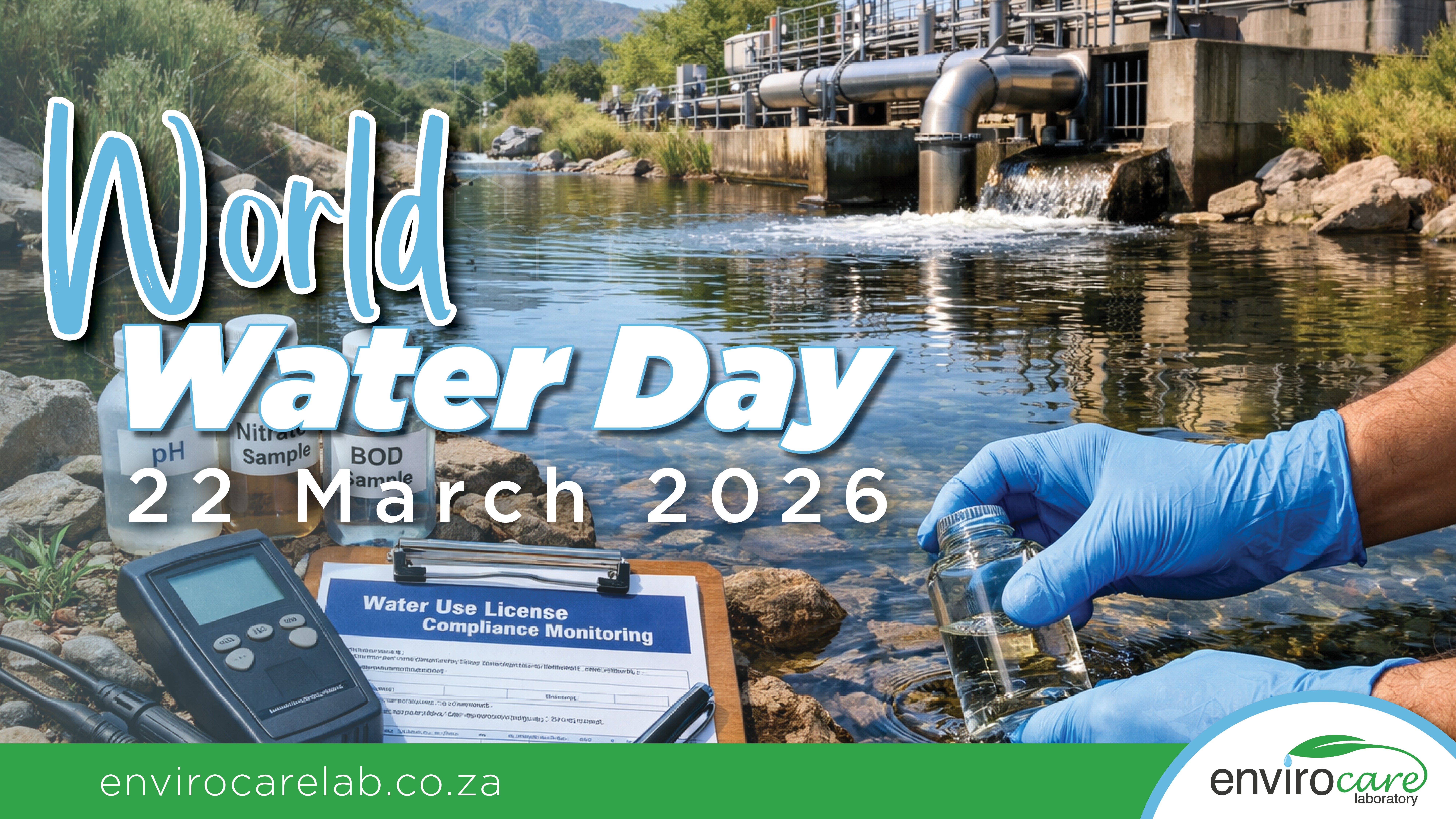
Managing industrial and commercial effluent is an important component of environmental compliance in South Africa. Businesses that discharge wastewater must comply with the legal requirements applicable to their operations, which may include a Water Use Licence (WUL) issued under the National Water Act, 1998 (Act No. 36 of 1998), a General Authorisation (GA), or municipal industrial effluent discharge requirements.
Where monitoring is required by a WUL, GA, or municipal discharge permit, routine laboratory testing plays a critical role in demonstrating compliance, protecting water resources, and providing objective evidence that wastewater quality is being appropriately monitored.
Failure to comply with applicable discharge conditions may result in enforcement action, financial penalties, increased regulatory oversight, operational disruption, and environmental harm. Routine effluent monitoring helps organisations identify potential issues early, allowing corrective actions to be implemented before non-compliance occurs.
What Is Effluent Testing?
Effluent testing is the laboratory analysis of wastewater before it is discharged to the environment or into a municipal sewer system. The purpose of testing is to determine whether the wastewater complies with the quality limits, monitoring requirements, and reporting obligations specified by the applicable regulatory authority.
Depending on the applicable authorisation, effluent monitoring may be required to:
- Demonstrate compliance with Water Use Licence (WUL) conditions.
- Verify compliance with General Authorisation (GA) requirements.
- Meet municipal industrial effluent discharge requirements.
- Support environmental monitoring and regulatory reporting.
- Identify trends that may indicate deteriorating wastewater quality.
- Assist in the optimisation of wastewater treatment processes.
Routine monitoring provides businesses with objective analytical data that supports informed operational decisions while reducing the risk of repeated non-compliance.
Who Requires Effluent Testing?
Effluent testing is commonly required across industries that generate industrial or commercial wastewater, including:
- Food and beverage manufacturers
- Abattoirs and meat processing facilities
- Dairy processors
- Agricultural processing operations
- Breweries and beverage producers
- Chemical manufacturers
- Pharmaceutical facilities
- Mining and mineral processing operations
- Municipal wastewater treatment works
- General manufacturing industries
- Fresh produce packhouses and processing facilities
The monitoring requirements, analytical parameters, sampling frequency, and reporting obligations vary according to the type of discharge, the receiving environment, and the conditions imposed by the relevant regulatory authority.
Understanding Water Use Licences, General Authorisations and Municipal Requirements
Many organisations refer to an “effluent discharge permit,” but wastewater discharges in South Africa may be regulated through different legal mechanisms depending on the nature of the water use.
These may include:
- A Water Use Licence (WUL) issued under the National Water Act.
- A General Authorisation (GA) issued under Section 39 of the National Water Act for qualifying water uses.
- Municipal industrial effluent discharge permits or sewer discharge agreements administered by local authorities.
These authorisations commonly specify:
- Monitoring locations.
- Sampling frequency.
- Analytical parameters.
- Maximum allowable discharge limits.
- Record-keeping requirements.
- Reporting obligations.
Businesses should always ensure that their monitoring programme aligns with the conditions contained in their specific authorisation.
Common Effluent Parameters Monitored
The analytical parameters required depend on the industry, wastewater characteristics, and the applicable regulatory requirements.
Envirocare Laboratory’s Chemical Department performs analysis for a broad range of chemical and microbiological parameters commonly included in industrial effluent monitoring programmes.
General Water Quality
- pH
- Electrical Conductivity (EC)
- Total Dissolved Solids (TDS)
- Total Suspended Solids (TSS)
- Turbidity
Organic Load Indicators
- Chemical Oxygen Demand (COD)
- Biological Oxygen Demand (BOD₅)
Nutrients
- Ammonia
- Nitrate
- Nitrite
- Orthophosphate and Phosphate
Major Ions
- Chloride
- Sulphate
Metals and Other Chemical Determinands
Where required by licence conditions or customer requirements, analysis may include regulated metals and other chemical constituents relevant to the industrial process.
Microbiological Parameters
Where microbiological monitoring is required, testing may include:
- Total Coliforms
- Escherichia coli (E. coli)
- Faecal Coliforms
- Other microbiological indicators relevant to the discharge
The analytical programme should always be based on the monitoring requirements contained within the applicable authorisation.
Why Routine Effluent Monitoring Matters
Routine monitoring provides benefits that extend beyond regulatory compliance.
Consistent laboratory testing helps organisations:
- Verify compliance with applicable discharge conditions.
- Monitor wastewater treatment performance.
- Detect changing wastewater characteristics.
- Identify developing compliance risks.
- Support environmental audits and management systems.
- Maintain reliable records for regulatory inspections.
- Demonstrate responsible environmental management.
By identifying trends over time, organisations can implement corrective actions before exceedances become recurring compliance issues.
What Happens if Effluent Exceeds Discharge Limits?
Analytical results that exceed the applicable discharge limits should be investigated promptly.
Depending on the applicable authorisation and the circumstances surrounding the exceedance, organisations may need to:
- Investigate the source of the elevated results.
- Assess the performance of wastewater treatment systems.
- Implement corrective or preventative actions.
- Increase monitoring where appropriate.
- Meet any reporting obligations specified by the relevant authority.
Early identification through routine monitoring enables businesses to respond proactively and minimise the likelihood of repeated non-compliance.
Effluent Sampling Considerations
Accurate laboratory results depend on representative sampling.
Monitoring programmes may require:
- Grab samples.
- Composite samples.
- Routine scheduled sampling.
- Event-based monitoring.
Appropriate sample collection, preservation, transportation, and chain-of-custody procedures are essential for obtaining reliable analytical results.
Envirocare Laboratory can provide guidance on sampling requirements and assist clients in developing monitoring programmes that align with their regulatory obligations.
How Envirocare Laboratory Supports Compliance
Envirocare Laboratory provides comprehensive laboratory support for organisations requiring routine industrial effluent monitoring.
Our services include:
- Chemical analysis of industrial and commercial effluent.
- Microbiological testing where required.
- Guidance on sampling requirements.
- Assistance with developing monitoring schedules based on customer requirements.
- Interpretation of laboratory results.
- Reliable analytical data to support environmental reporting and compliance programmes.
Our experienced team works with clients across multiple industries to deliver accurate, dependable laboratory results that support effective environmental management.
Partner with Envirocare Laboratory
Reliable laboratory testing is an essential component of effective environmental management and regulatory compliance.
Envirocare Laboratory provides comprehensive chemical and microbiological effluent testing to support businesses in meeting their monitoring obligations, managing environmental risk, and maintaining confidence in the quality of their wastewater monitoring programmes.
Contact Envirocare Laboratory
📧 Email: info@envirocarelab.co.za
📞 Tel: +27 18 294 4283
🌐 Website: https://envirocarelab.co.za/
References
- Republic of South Africa. National Water Act, 1998 (Act No. 36 of 1998). Pretoria: Government Printer.
- Department of Water and Sanitation (DWS). Water Use Authorisation System (e-WULAAS). Available at: https://www.dws.gov.za/ewulaas/
- Department of Water and Sanitation (DWS). General Authorisations issued under Section 39 of the National Water Act. Pretoria: Republic of South Africa.
- Department of Water and Sanitation (DWS). National Water Act: Regulations and Notices relating to Water Use Authorisations and Waste Discharge. Pretoria: Republic of South Africa.
- South African Bureau of Standards (SABS). SANS 5667 (latest applicable edition): Water Quality — Sampling. Pretoria: SABS.
- ISO. ISO 5667 (relevant parts): Water Quality — Sampling. International Organization for Standardization, Geneva.
