


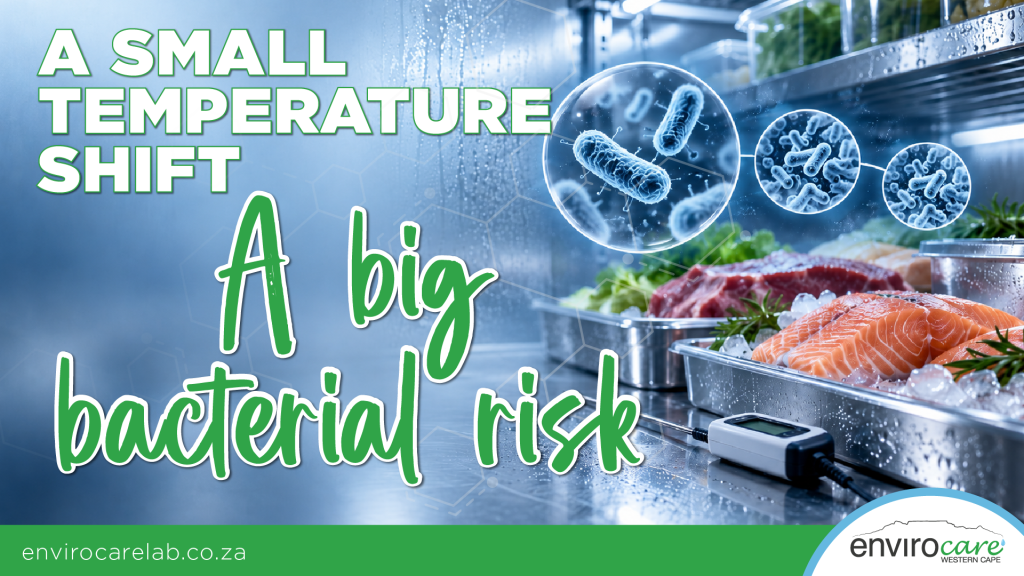
Temperature abuse in food is an important food safety concern because temperature directly influences the rate at which microorganisms can multiply. Even relatively short periods outside controlled storage conditions can affect the microbial load of a product.
For food producers, understanding the relationship between time, temperature and bacterial growth is essential for maintaining food safety, product quality and shelf life.
How Temperature Affects Bacterial Growth in Food
Temperature is one of the major factors influencing microbial growth in food. Different microorganisms have different minimum, optimum and maximum temperatures for growth. When conditions approach the optimum temperature for a particular organism, its metabolic activity and growth rate can increase significantly.
However, temperature does not act alone. pH, water activity, nutrient availability, oxygen and preservatives can also influence whether microorganisms grow and how rapidly they multiply.
This means that there is no single temperature at which all bacteria grow at the same rate. The response depends on both the microorganism and the characteristics of the food.
Exponential Bacterial Growth
When environmental conditions are favourable, bacteria can enter an exponential or log-growth phase, during which the population increases through repeated cell division.
For example, if a bacterial population has a generation time of 20 minutes, the theoretical progression could be:
1 → 2 → 4 → 8 → 16 → 32 → 64 → 128
This illustrates why bacterial growth in food can become significant over relatively short periods.
The 20-minute example is not a universal bacterial growth rate. Generation time varies between microorganisms and environmental conditions. However, USDA Food Safety and Inspection Service information notes that some bacteria can double in number in as little as 20 minutes under favourable conditions.
The important principle is that small increases in microbial numbers can become much larger through repeated generations.
What Is Temperature Abuse in Food?
Temperature abuse occurs when food is exposed to temperatures that allow microorganisms to grow more rapidly than intended by the food safety or storage controls.
This can occur during:
- Cooling
- Refrigerated storage
- Loading and unloading
- Transportation
- Distribution
- Retail storage
- Food preparation
Temperature abuse does not necessarily mean that food becomes visibly warm or remains at an elevated temperature for a very long period.
The combination of time and temperature is what matters.
A short temperature excursion may have limited impact in one product but a much greater effect in another, depending on its microbial population, formulation and intrinsic properties.
Why the Microbial Baseline Can Change
Consider a refrigerated product with an initial microbial population.
Under controlled refrigeration, the growth of many microorganisms may be slow.
If the product is exposed to a more favourable growth temperature, however, susceptible microorganisms may multiply more rapidly.
When the product is returned to refrigeration, further growth may slow.
But the important point is:
The microbial population does not return to its original level simply because the temperature decreases.
If bacterial numbers increased during the temperature excursion, the product now has a higher microbial load from which subsequent growth can occur.
In simple terms:
Cooling can slow bacterial growth. It does not reverse bacterial multiplication that has already occurred.
This is why the temperature history of food can be just as important as the temperature measured at a single point in time.
Refrigeration and Bacterial Growth
Refrigeration is an important food temperature control measure because lower temperatures generally reduce the growth rate of many microorganisms.
However, refrigeration does not eliminate microorganisms.
Some microorganisms can survive at refrigeration temperatures, and certain organisms are capable of growing under refrigerated conditions. Listeria monocytogenes, for example, can multiply at refrigeration temperatures, although growth is slower at lower temperatures.
For this reason, refrigeration should be regarded as a growth-control measure, rather than a method of eliminating microbial hazards.
Effective temperature control must therefore be considered together with:
- Product shelf life
- pH
- Water activity
- Packaging
- Preservatives
- Initial microbial load
- Storage conditions
- The microorganisms of concern
Why the Cold Chain Matters
Maintaining the cold chain is an important part of food safety because it limits the amount of time microorganisms spend under conditions that support rapid growth.
Temperature control should therefore extend beyond the production environment to include:
Production → Cooling → Storage → Transport → Distribution → Retail → Consumer
A product may eventually return to its required storage temperature after a temperature excursion, but its microbial history cannot simply be reset.
This is why cold chain management and temperature monitoring are important components of an effective food safety system.
Time and Temperature: A Food Safety Perspective
The relationship between time and temperature in food safety is fundamentally about controlling microbial growth.
Temperature influences the rate at which microorganisms can grow, while time determines how long they have the opportunity to multiply.
A useful way to think about it is:
Higher growth rate + longer exposure = greater potential for microbial multiplication.
This does not mean that every temperature deviation will result in unsafe food. Risk depends on the organism present, the food matrix and the duration and severity of the temperature excursion.
However, preventing unnecessary temperature fluctuations reduces the opportunity for microbial growth.
The Importance of Temperature Control
Effective food temperature control is therefore more than simply checking whether a product is cold when it is received or stored.
It involves controlling the conditions that influence microbial growth throughout the product’s journey.
For food producers, understanding temperature abuse in food can help identify weaknesses in cooling, storage, transportation and handling processes.
Microbiological testing can then provide valuable information for verifying the effectiveness of food safety controls and monitoring the microbiological quality of products.
The Key Takeaway
Temperature affects bacterial growth. Time provides the opportunity for that growth to occur.
Even a relatively short period of temperature abuse can allow susceptible microorganisms to multiply, potentially increasing the microbial load of a product.
Returning the product to refrigeration may slow further growth, but it does not undo the multiplication that has already occurred.
The temperature can go down — but the microbial population may not.
Understanding and controlling the relationship between time, temperature and bacterial growth is therefore an important part of effective food safety and cold chain management.
Test for What Matters.
References
- U.S. Food and Drug Administration (FDA). (2012). Bad Bug Book: Handbook of Foodborne Pathogenic Microorganisms and Natural Toxins. 2nd ed. Silver Spring, MD: U.S. Food and Drug Administration.
- U.S. Department of Agriculture, Food Safety and Inspection Service (USDA-FSIS). (2024). How Temperatures Affect Food. Washington, DC: USDA-FSIS.
- World Health Organization (WHO). (2006). Five Keys to Safer Food Manual. Geneva: World Health Organization.
- World Health Organization (WHO). (2024). Five Keys to Safer Food. Geneva: World Health Organization.
- U.S. Food and Drug Administration (FDA). (2003). Listeria monocytogenes Risk Assessment Questions and Answers. Silver Spring, MD: U.S. Food and Drug Administration.
