


Food businesses have many microbiological hazards to consider, but some risks can be particularly challenging because they are closely linked to food handling and hygiene.
Staphylococcus aureus is one of them.
Testing for Staphylococcus aureus can form an important part of a food business’s food safety and quality monitoring programme, helping provide information about potential contamination and whether hygiene and handling controls are working effectively.
But why should businesses test for S. aureus in the first place?
Staphylococcus aureus: A Food Safety Concern
Staphylococcus aureus can be carried by healthy people, meaning that food can potentially become contaminated during handling and preparation even when the person carrying the bacterium does not appear ill.
The organism can also be associated with animals, raw materials, equipment and food-contact environments.
The concern goes beyond simply finding bacteria in a product.
Certain strains of S. aureus can produce staphylococcal enterotoxins. When conditions allow the organism to multiply in food, these toxins can potentially accumulate and cause foodborne illness.
This makes S. aureus an important organism to consider when evaluating food safety controls.
Why Should Food Businesses Test for Staphylococcus aureus?
1. To verify food safety controls
Food businesses put procedures in place to prevent contamination.
But how do you know those controls are actually working?
Testing provides evidence.
Routine microbiological testing can help businesses monitor their products and verify that their food safety controls are performing as expected.
Testing can therefore complement other measures such as:
- Personal hygiene
- Cleaning and sanitation
- Temperature control
- Cross-contamination prevention
- Good manufacturing practices
- Staff training
- Appropriate food handling
Testing does not replace these controls — it helps verify them.
2. To identify potential hygiene problems
Because S. aureus can be associated with people and food handling, its presence at concerning levels may indicate that a business needs to take a closer look at its hygiene and handling practices.
This can be particularly important for foods that are:
- Extensively handled
- Prepared without a further cooking step
- Ready-to-eat
- Stored for extended periods
- Produced in environments where multiple products are handled
A test result can therefore be a useful starting point for investigating where improvements may be needed.
3. To support product quality monitoring
Food safety and product quality go hand in hand.
A food product may look, smell and taste completely normal while still requiring microbiological assessment.
Routine testing can provide food businesses with objective information about their products, rather than relying solely on visual inspection or assumptions about hygiene.
This can be particularly valuable for businesses producing food on a regular basis, where consistent microbiological quality is important.
4. To detect contamination before it becomes a bigger problem
Nobody wants to discover a microbiological problem after a product has already reached customers.
Regular testing can form part of a proactive monitoring programme, allowing businesses to identify potential issues and investigate them before they develop into larger food safety concerns.
A well-planned testing programme can help businesses identify trends over time rather than looking at individual results in isolation.
For example, repeated increases in a particular organism may prompt a review of:
- Cleaning procedures
- Staff hygiene
- Production practices
- Raw materials
- Equipment
- Storage conditions
- Cross-contamination risks
5. To support shelf-life and product assessments
As products move through their intended shelf life, their microbiological characteristics can change.
For some products, S. aureus testing may form part of a broader microbiological assessment or shelf-life study, depending on the product and applicable requirements.
This can help businesses evaluate whether their products remain within their specified microbiological parameters throughout their intended shelf life.
6. To support customer and regulatory requirements
Food manufacturers may need to demonstrate that their products meet customer specifications, internal standards or applicable microbiological requirements.
Laboratory testing can provide documented evidence that can support quality assurance systems and customer requirements.
For businesses supplying retailers, wholesalers, hospitality groups or other food manufacturers, having a structured microbiological testing programme can also provide greater confidence in product quality.
Which Food Products May Require Staphylococcus aureus Testing?
The need for testing depends on the type of product, ingredients, processing, handling, storage and applicable requirements.
Products where S. aureus may be relevant can include:
- Meat and meat products
- Poultry products
- Dairy products
- Ready-to-eat foods
- Prepared foods
- Bakery products
- Cream-filled products
- Salads and other extensively handled foods
- Food ingredients
- Other processed food products
The important point is that not every food product has the same risk profile.
A testing programme should therefore be based on the individual product and the food safety risks associated with its production and handling.
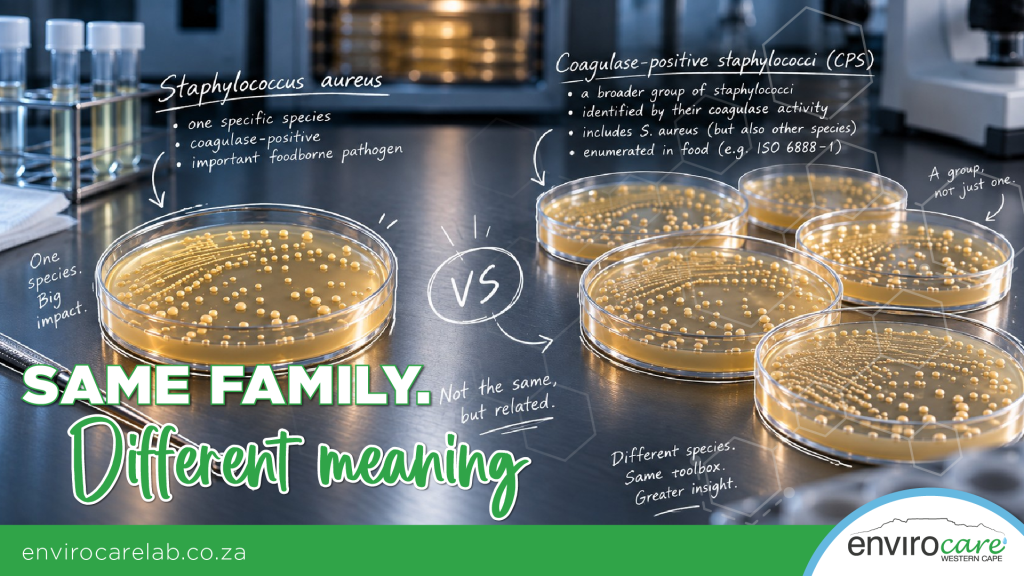
What About Coagulase-Positive Staphylococci?
You may also see the term coagulase-positive staphylococci (CPS) when discussing food microbiology.
So, is that the same as Staphylococcus aureus?
Not quite.
Staphylococcus aureus is a specific species of Staphylococcus. Coagulase-positive staphylococci is a broader group, which includes S. aureus as well as certain other staphylococci.
This is why food businesses may encounter either S. aureus or coagulase-positive staphylococci terminology depending on the testing requirement, specification or applicable method.
For businesses, the important thing is to ensure that the test selected matches the question being asked and the applicable requirements for the product.
What Can You Do If Staphylococcus aureus Is Detected?
A result indicating S. aureus should not simply be viewed as a number on a laboratory report.
Depending on the result and the product, it may be appropriate to investigate potential sources of contamination.
A business may review:
Personnel hygiene
Are food handlers following appropriate handwashing and hygiene procedures?
Cleaning and sanitation
Are food-contact surfaces and equipment being effectively cleaned?
Production practices
Could contamination be occurring during preparation, processing or packaging?
Cross-contamination
Could bacteria be transferring between raw materials, equipment, people and finished products?
Storage and temperature control
Are products being stored under appropriate conditions?
Raw materials
Could contamination be entering the production process through incoming ingredients?
The appropriate response will depend on the product, result and circumstances surrounding the finding.
Testing Is Part of a Bigger Food Safety Picture
Testing for Staphylococcus aureus is not about replacing good hygiene practices.
It is about checking, verifying and understanding what is happening within your food safety system.
A strong food safety programme combines preventive controls with appropriate monitoring and verification.
That can give businesses greater confidence that the controls they have implemented are actually supporting the microbiological quality and safety of their products.
Need Staphylococcus aureus Testing?
Envirocare Western Cape supports food businesses with microbiological testing to help monitor product quality and food safety.
Whether you are establishing a routine testing programme, investigating a concern, conducting product assessments or need testing to support your quality requirements, our team can assist with your microbiological testing needs.
Don’t wait for a food safety problem to tell you that something went wrong. Testing can help you identify potential issues and make informed decisions about your products.
Envirocare Laboratory – Your Partner in Compliance Success.
Envirocare Western Cape
+27 82 343 9579
+27 81 834 7198
info_westerncape@envirocarelab.co.za
Envirocare Laboratory
018 294 4283
071 353 5740
info@envirocarelab.co.za
References
- World Health Organization (WHO). 2018. Staphylococcus aureus. WHO Food Safety Fact Sheet. Geneva: World Health Organization.
This is useful for supporting the food-safety significance of S. aureus, contamination and staphylococcal food poisoning. - U.S. Food and Drug Administration (FDA). 2022. Bad Bug Book: Foodborne Pathogenic Microorganisms and Natural Toxins Handbook – Staphylococcus aureus. Silver Spring, MD: U.S. Food and Drug Administration.
Useful for supporting information about S. aureus, food contamination, enterotoxins and foodborne illness. - Hennekinne, J.-A., De Buyser, M.-L. & Dragacci, S. 2012. Staphylococcus aureus and its food poisoning toxins: characterization and outbreak investigation. FEMS Microbiology Reviews, 36(4), pp.815–836.
This is a strong scientific reference for the relationship between S. aureus, enterotoxins and food poisoning. - Argudín, M.A., Mendoza, M.C. & Rodicio, M.R. 2010. Food poisoning and Staphylococcus aureus enterotoxins. Toxins, 2(7), pp.1751–1773.
Supports the discussion of staphylococcal enterotoxins and their role in foodborne illness. - International Organization for Standardization (ISO). 2021. ISO 6888-1:2021 Microbiology of the food chain — Horizontal method for the enumeration of coagulase-positive staphylococci (Staphylococcus aureus and other species) — Part 1: Method using Baird-Parker agar medium. Geneva: ISO.
This is the reference I would use specifically for your “What About Coagulase-Positive Staphylococci?” section. It confirms that the term refers to S. aureus and other species, rather than being a testing method itself. - Codex Alimentarius Commission. 2022. General Principles of Food Hygiene CXC 1-1969. Rome: FAO/WHO.
Useful as a broader reference for your discussion of hygiene, food safety controls, contamination prevention and verification.
