


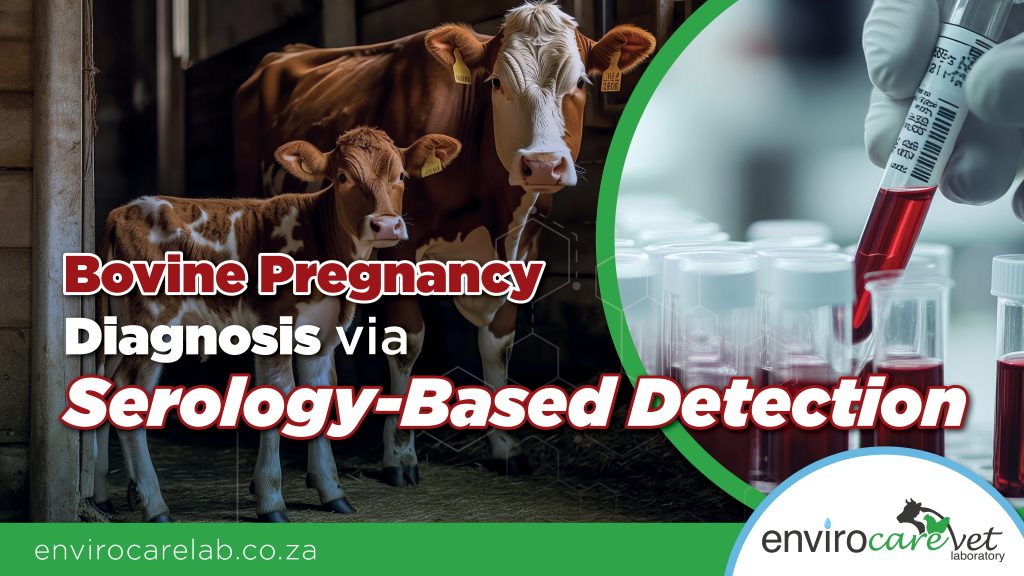
Efficient reproduction is fundamental to profitable cattle farming. Knowing whether a cow is pregnant as early as possible allows producers to make informed breeding and herd-management decisions, helping to improve reproductive efficiency, reduce unnecessary costs and optimise herd productivity.
A cattle pregnancy blood test provides a convenient, minimally invasive method for early bovine pregnancy diagnosis. Serology-based testing detects Pregnancy-Associated Glycoproteins (PAGs) in the cow’s bloodstream, which are produced by the developing placenta during pregnancy.
Depending on the testing method and stage of pregnancy, PAG-based testing can be used from approximately 28 days after breeding or artificial insemination.
Whether you manage a commercial beef herd or a dairy operation, early pregnancy testing can help identify open cows sooner and provide valuable information for breeding and management decisions.
Cattle Pregnancy Blood Testing at Envirocare Laboratory
Envirocare Laboratory provides serology-based bovine pregnancy testing for cattle.
Our testing uses blood samples to detect pregnancy-associated markers, providing producers with laboratory-based information to support reproductive management.
Key information:
- Test: Bovine pregnancy serology
- Marker: Pregnancy-Associated Glycoproteins (PAGs)
- Sample: Blood/serum
- Testing: From approximately 28 days after breeding, depending on the testing method and pregnancy stage
- Purpose: Early pregnancy diagnosis in cattle
- Location: South Africa
For sample requirements, submission procedures and current turnaround times, contact our laboratory team before submitting samples.
Why Early Pregnancy Testing in Cattle Matters
Early pregnancy diagnosis gives producers information that can be used to make timely management decisions.
Identifying non-pregnant cows sooner can allow producers to consider rebreeding, culling, nutritional adjustments or other appropriate management strategies rather than carrying open animals through an extended period.
Early cattle pregnancy testing can help producers to:
- Identify open cows sooner
- Support earlier rebreeding decisions
- Reduce unnecessary days open
- Optimise nutritional management
- Support culling and replacement decisions
- Monitor reproductive programme performance
- Improve overall herd reproductive efficiency
The value of early pregnancy testing lies not only in confirming pregnancy, but in providing information early enough to support better herd-management decisions.
What Is a Cattle Pregnancy Blood Test?
A blood pregnancy test for cattle is a laboratory diagnostic test that detects Pregnancy-Associated Glycoproteins (PAGs) in a cow’s blood.
PAGs are produced by specialised cells associated with the developing placenta. These proteins enter the maternal bloodstream during pregnancy and can therefore be used as biological markers for pregnancy.
PAG testing provides a way to assess pregnancy status without requiring a rectal examination or ultrasound examination of the reproductive tract.
The timing of testing is important because PAG concentrations change during pregnancy. Testing should therefore be performed according to the requirements of the specific assay and the recommended period after breeding.
Advantages of Blood Pregnancy Testing in Cattle
PAG-based serology offers several practical advantages for cattle producers.
| Traditional Pregnancy Diagnosis | Serology-Based Blood Testing |
|---|---|
| May require a skilled veterinarian or trained technician | Requires collection of a blood sample |
| Timing depends on the diagnostic method | Can provide early pregnancy assessment |
| Rectal examination involves manipulation of the reproductive tract | No reproductive-tract examination is required |
| Ultrasound requires appropriate equipment and operator expertise | Samples can be submitted to a laboratory |
| Results depend on the selected diagnostic approach | Laboratory-based testing provides a standardised test result |
Blood testing does not replace veterinary examination in every situation. Instead, it provides another useful diagnostic option that can be incorporated into an appropriate herd reproductive programme.
When Should Cattle Be Tested for Pregnancy?
The appropriate testing time depends on the diagnostic method being used.
For PAG-based pregnancy testing, cattle can generally be tested from approximately 28 days after breeding, subject to the requirements of the specific test method.
Testing too early can affect the reliability of a pregnancy assessment because PAG concentrations may not yet be sufficiently detectable.
Where confirmation of ongoing pregnancy is required, a later pregnancy assessment may also be considered. This can be particularly useful because pregnancy loss can occur during early gestation.
Your veterinarian can help determine the most appropriate testing schedule based on your herd, breeding programme and management objectives.
Why Test Open Cows Early?
An open cow represents more than simply a negative pregnancy result. Extended periods between breeding and confirmed pregnancy can affect overall herd reproductive performance.
Early identification of open animals gives producers an opportunity to make decisions sooner.
Depending on the production system, these decisions may include:
- Rebreeding eligible cows
- Reviewing reproductive management
- Assessing nutritional status
- Investigating potential reproductive problems
- Adjusting herd-management plans
- Considering culling decisions where appropriate
Early information can therefore contribute to more efficient use of feed, labour and other farm resources.
Cattle Pregnancy Blood Testing vs Other Pregnancy Diagnosis Methods
Several methods are available for diagnosing pregnancy in cattle, including rectal palpation, ultrasonography and blood-based testing.
Rectal Palpation
Rectal palpation is a well-established method of pregnancy diagnosis and requires a suitably trained veterinarian or technician.
Ultrasonography
Ultrasound can provide detailed information about the reproductive tract and developing pregnancy. It can also be useful when additional reproductive assessment is required.
PAG Blood Testing
PAG testing uses a blood sample to detect pregnancy-associated proteins. This provides producers with a laboratory-based option for early pregnancy assessment.
The most appropriate method depends on the herd, timing, available expertise, testing objective and management system.
The Envirocare Laboratory Testing Process
At Envirocare Laboratory, we aim to make bovine pregnancy testing straightforward for producers and veterinary professionals.
Step 1: Blood samples are collected from the cattle by a veterinarian or appropriately trained personnel.
Step 2: Samples are submitted to Envirocare Laboratory according to the required sample-handling and submission procedures.
Step 3: The samples are analysed using the applicable serology-based pregnancy testing method.
Step 4: Laboratory results are reported clearly for use by the producer or veterinary professional in herd-management decisions.
For current sample requirements and turnaround times, contact Envirocare Laboratory before submitting samples.
Why Choose Envirocare Laboratory for Bovine Pregnancy Testing?
Envirocare Laboratory provides laboratory-based veterinary diagnostic services designed to support informed animal-health and production decisions.
Our laboratory combines scientific expertise, established quality systems and veterinary diagnostic capabilities to provide dependable testing services.
For cattle producers, early pregnancy testing can help provide information to:
- Improve reproductive monitoring
- Identify open cows earlier
- Support breeding decisions
- Manage herd performance
- Investigate reproductive challenges
- Improve the efficiency of reproductive programmes
Important: Envirocare Laboratory is ISO/IEC 17025:2017 accredited for applicable testing methods within its current accredited scope. Accreditation applies only to the methods and matrices included in the applicable SANAS scope.
Early Pregnancy Testing as Part of a Broader Reproductive Programme
Pregnancy diagnosis is one component of successful cattle reproductive management.
Where a herd experiences poor conception rates, repeat breeding, abortions or other reproductive problems, additional investigation may be required.
Infectious reproductive diseases such as Trichomonas foetus and Campylobacter fetus can also affect reproductive performance. Appropriate laboratory testing can assist veterinarians and producers when investigating potential infectious causes of reproductive problems.
Pregnancy testing and reproductive-disease testing therefore serve different purposes but can complement one another within a broader herd-health programme.
Improve Herd Reproductive Management with Early Pregnancy Testing
Early cattle pregnancy diagnosis provides producers with valuable information when it matters most.
By identifying pregnant and open animals earlier, producers can make more informed breeding, nutritional and herd-management decisions. When incorporated into a broader reproductive programme, laboratory-based pregnancy testing can contribute to improved reproductive efficiency and more effective herd management.
If you are looking for cattle pregnancy testing in South Africa, Envirocare Laboratory provides serology-based bovine pregnancy diagnostics for producers and veterinary professionals.
Contact Envirocare Laboratory
Take the uncertainty out of herd reproduction with laboratory-based blood pregnancy testing for cattle.
Telephone: +27 18 294 4283 | +27 71 353 5740
Email: info@envirocarelab.co.za
Our team can assist with sample requirements, testing information and submission procedures.
Envirocare Laboratory — Your Partner in Compliance Success.
References
- Butler, W.R. (2000). Nutritional interactions with reproductive performance in dairy cattle. Animal Reproduction Science, 60–61, 449–457.
- Diskin, M.G. & Morris, D.G. (2008). Embryonic and early foetal losses in cattle and other ruminants. Reproduction in Domestic Animals, 43, 260–267.
- Fricke, P.M., Ricci, A., Giordano, J.O. & Carvalho, P.D. (2016). Methods for and implementation of pregnancy diagnosis in dairy cattle. Veterinary Clinics of North America: Food Animal Practice, 32(2), 165–180.
- Giordano, J.O., Fricke, P.M., Guenther, J.N., Lopes, G. Jr., Herlihy, M.M., Nascimento, A.B. & Wiltbank, M.C. (2013). Effect of reproductive management strategies on reproductive performance and economics of dairy herds. Journal of Dairy Science.
- Green, J.A., Parks, T.E., Avalle, M.P., et al. (2005). The establishment of an ELISA for the detection of pregnancy-associated glycoproteins in cattle. Biology of Reproduction, 73(1), 49–57.
- Green, J.C., Newsom, E.M., Eliason, C.M., Roberts, A.J., Geary, T.W. & Pohler, K.G. (2009). Pregnancy-associated glycoproteins contribute to pregnancy diagnosis and assessment of embryonic loss in cattle. Theriogenology.
- Pohler, K.G., Pereira, M.H.C., Lopes, F.R., et al. (2016). Circulating pregnancy-associated glycoproteins and their use in pregnancy diagnosis and assessment of pregnancy loss in cattle. Journal of Animal Science.
- Romano, J.E., Thompson, J.A., Forrest, D.W., Westhusin, M.E., Tomaszweski, M.A. & Kraemer, D.C. (2006). Early pregnancy diagnosis by transrectal ultrasonography in cattle. Theriogenology, 66(4), 1030–1037.
