

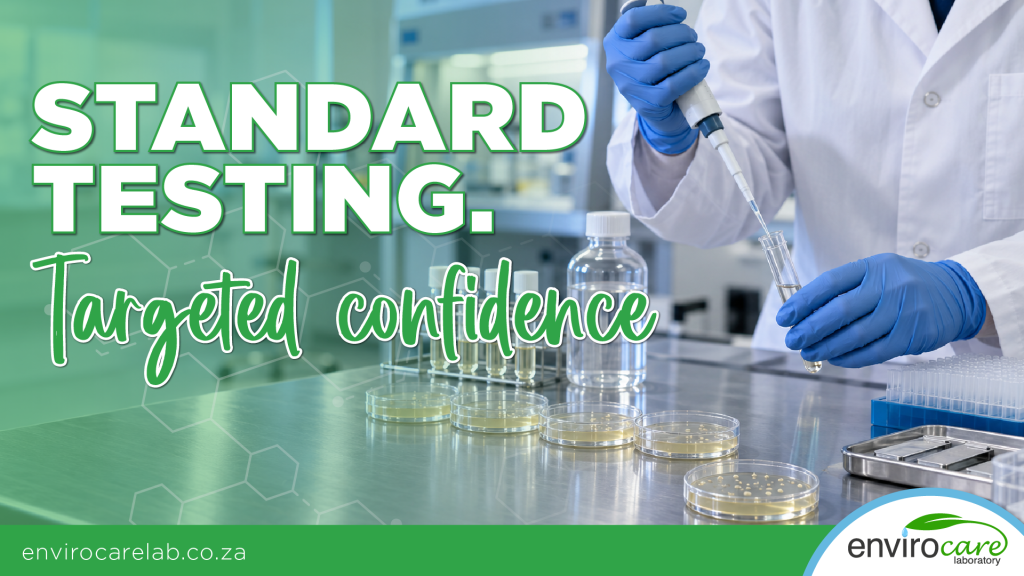
Disinfectant efficacy testing provides manufacturers with scientific evidence that a disinfectant performs as intended against defined microorganisms under specified test conditions.
Standardised testing is an important part of demonstrating product performance and meeting applicable requirements. However, there are situations where a manufacturer or end user may need additional information that goes beyond the standard test organisms.
For example, a disinfectant may need to be evaluated against a specific target organism relevant to its intended application. Alternatively, a manufacturer or production facility may be dealing with a recurring microbiological problem and want to investigate whether its disinfectant is effective against a strain associated with the client’s own environment.
This is where SANAS-accredited Flexible Scope disinfectant testing can provide a more targeted approach.
At Envirocare Laboratory, our Flexible Scope capability supports the consideration of additional disinfectant efficacy testing requirements within the defined boundaries of the accredited scope and applicable methodology.
What Is Flexible Scope Disinfectant Testing?
Flexible Scope, often referred to as Flexi Scope, provides an accredited laboratory with defined flexibility within its accredited testing activities.
For disinfectant efficacy testing, this can allow appropriate consideration of testing requirements involving different organisms, applications or recognised methods within the laboratory’s approved scope.
To learn more about Envirocare’s expanded accredited capabilities, read our article on [SANAS-accredited Flexible Scope disinfectant testing].
Flexible Scope does not mean replacing standardised testing. Standard test methods remain an important foundation for demonstrating disinfectant efficacy and compliance.
Instead, Flexible Scope can provide an opportunity to address additional, scientifically relevant testing requirements when a client’s needs extend beyond the standard test.
1. Testing Against a Specific Target Organism
Standard disinfectant efficacy testing uses defined challenge organisms according to the applicable testing method.
For example, routine bactericidal testing may use organisms specified by the relevant standard. These standard organisms provide a consistent basis for evaluating disinfectant performance.
But what if there is another microorganism that is particularly relevant to your product or intended application?
A manufacturer may want to demonstrate efficacy against an additional target organism because that organism is relevant to:
- The intended application of the disinfectant
- A customer’s technical specification
- A particular industry or production environment
- Product development
- A specific microbiological concern
- Additional product performance information
Through Flexible Scope, Envirocare Laboratory can assess the feasibility of incorporating a specific target organism into the disinfectant efficacy testing programme, where scientifically and methodologically appropriate.
Standard testing versus targeted organism testing
The distinction is important.
Standard testing asks:
Does the disinfectant meet the requirements of the applicable test method?
Targeted testing can additionally ask:
Can the disinfectant demonstrate efficacy against a specific organism that is relevant to the product or application?
The objective is not simply to perform more testing.
It is to generate relevant efficacy data that answers a meaningful question about the disinfectant’s intended use.
For information on routine bactericidal, fungicidal and yeasticidal testing, see our article on [SANS 51276 and SANS 51650 disinfectant testing].
2. Testing Against a Strain from the Client’s Environment
A different situation occurs when a client is dealing with an actual microbiological problem within a specific plant, production facility or environment.
For example, a facility may repeatedly recover a particular microorganism from an area despite having an established cleaning and disinfection programme.
In this situation, the client may want to know whether the disinfectant is effective against the organism associated with the problem rather than relying solely on testing against a defined standard strain.
This creates an opportunity for a more site-specific disinfectant testing approach.
Where appropriate, Envirocare Laboratory can assist with the isolation and identification of a relevant organism from a client’s environment and assess the feasibility of testing the disinfectant against the specific strain isolated from that environment, within the applicable accredited scope and methodology.
From the client’s plant to the laboratory
A site-specific investigation may involve several stages:
1. Identify the problem
The client identifies a recurring or significant microbiological concern within a particular plant, production area or environment.
2. Obtain an appropriate sample
Relevant environmental samples are collected using suitable sampling procedures.
3. Isolate the organism
The laboratory works to isolate the microorganism associated with the identified concern.
4. Identify the isolate
The recovered organism is identified using appropriate microbiological or analytical techniques.
5. Evaluate disinfectant efficacy
Where scientifically and methodologically appropriate, the disinfectant can then be evaluated against the relevant strain within the applicable Flexible Scope.
This approach creates a stronger connection between the real-world microbiological problem and the laboratory efficacy investigation.
What Is the Difference Between Target Organism and Site-Specific Strain Testing?
Although both approaches involve more targeted disinfectant efficacy testing, they address different questions.
| Approach | What is being targeted? | Main question |
|---|---|---|
| Specific target organism testing | An organism relevant to the product or application | “Can my disinfectant demonstrate efficacy against this specific organism?” |
| Client-specific strain testing | A strain associated with the client’s environment | “Can my disinfectant demonstrate efficacy against the strain associated with our actual site problem?” |
This distinction is important.
Target organism testing does not necessarily mean that the organism came from the client’s facility. The manufacturer may simply want additional efficacy information against a particular organism relevant to the intended application.
Site-specific strain testing, on the other hand, begins with a microbiological concern within a particular environment and may involve isolating the organism or strain associated with that concern.
Why Consider Targeted Disinfectant Testing?
Standard disinfectant efficacy testing remains essential for demonstrating product performance according to applicable requirements.
However, additional targeted testing may provide valuable information when a client’s testing objective goes beyond standard compliance.
Potential applications include:
- Evaluating a disinfectant against a specific target organism
- Supporting product development
- Generating additional product efficacy data
- Investigating recurring microbiological problems
- Assessing disinfectant performance against a site-associated strain
- Supporting customer-specific technical requirements
- Investigating the effectiveness of a disinfectant against organisms relevant to a particular production environment
The goal is not simply to increase the number of organisms tested.
The goal is to ensure that the testing programme answers the right scientific question.
Don’t Just Comply. Test for What Matters.
Compliance testing provides an important foundation for disinfectant products.
But in some situations, the most valuable question may be more specific:
Does this disinfectant work against the organism that matters to my product?
Or, when dealing with a plant-specific problem:
Does this disinfectant work against the organism we are actually dealing with on site?
SANAS-accredited Flexible Scope testing provides an opportunity to consider these additional testing requirements within the defined boundaries of the laboratory’s accredited scope and applicable methodology.
Whether you need to investigate a specific target organism or a strain associated with your own production environment, the first step is to define the testing objective and determine the appropriate scientific approach.
For a broader introduction to disinfectant efficacy, testing terminology and validation principles, read our guide to [chemical disinfectant validation].
Why Choose Envirocare Laboratory?
Choosing a disinfectant testing laboratory is about more than obtaining a test result. The laboratory should understand the scientific objective behind the testing and help determine the appropriate testing pathway.
Envirocare Laboratory offers:
- SANAS-accredited chemical disinfectant efficacy testing
- A SANAS-accredited Flexible Scope supporting a broader range of recognised efficacy testing
- Testing across food, industrial, institutional, medical and veterinary applications
- Experienced microbiology and technical personnel
- Support for standard and targeted disinfectant efficacy testing requirements
- Testing against relevant target organisms where scientifically and methodologically appropriate
- Investigation of organisms associated with client environments, where applicable
- Scientifically robust laboratory reporting
Envirocare’s Biocidal Validation Unit provides accredited disinfectant efficacy testing and validation for manufacturers across food, healthcare, veterinary, pharmaceutical and industrial sectors.
Our broader Flexible Scope capability includes recognised SANS and EN efficacy methods across food, industrial, domestic, institutional, medical and veterinary applications.
Don’t just comply. Test for what matters.
Contact Envirocare Laboratory to discuss your target organism, site-specific strain or Flexible Scope disinfectant testing requirements.
References
- International Organization for Standardization (ISO). 2017. ISO/IEC 17025:2017 – General requirements for the competence of testing and calibration laboratories. Geneva: ISO. ISO describes ISO/IEC 17025 as the international standard for the competence, impartiality and consistent operation of testing and calibration laboratories.
- South African Bureau of Standards (SABS). SANS 51276 – Chemical disinfectants and antiseptics – Quantitative suspension test for the evaluation of bactericidal activity of chemical disinfectants and antiseptics used in food, industrial, domestic and institutional areas. Pretoria: SABS.
- South African Bureau of Standards (SABS). SANS 51650 – Chemical disinfectants and antiseptics – Quantitative suspension test for the evaluation of fungicidal or yeasticidal activity of chemical disinfectants used in food, industrial, domestic and institutional areas. Pretoria: SABS.
- South African Bureau of Standards (SABS). SANS 53704 – Chemical disinfectants and antiseptics – Quantitative suspension test for the evaluation of sporicidal activity of chemical disinfectants used in food, industrial, domestic and institutional areas. Pretoria: SABS.
- National Regulator for Compulsory Specifications (NRCS). 2017. VC8054:2017 – Compulsory Specification for Chemical Disinfectants. Pretoria: NRCS.
- European Committee for Standardization (CEN). 2018. EN 14885:2018 – Chemical disinfectants and antiseptics – Application of European Standards for chemical disinfectants and antiseptics. Brussels: CEN.
