


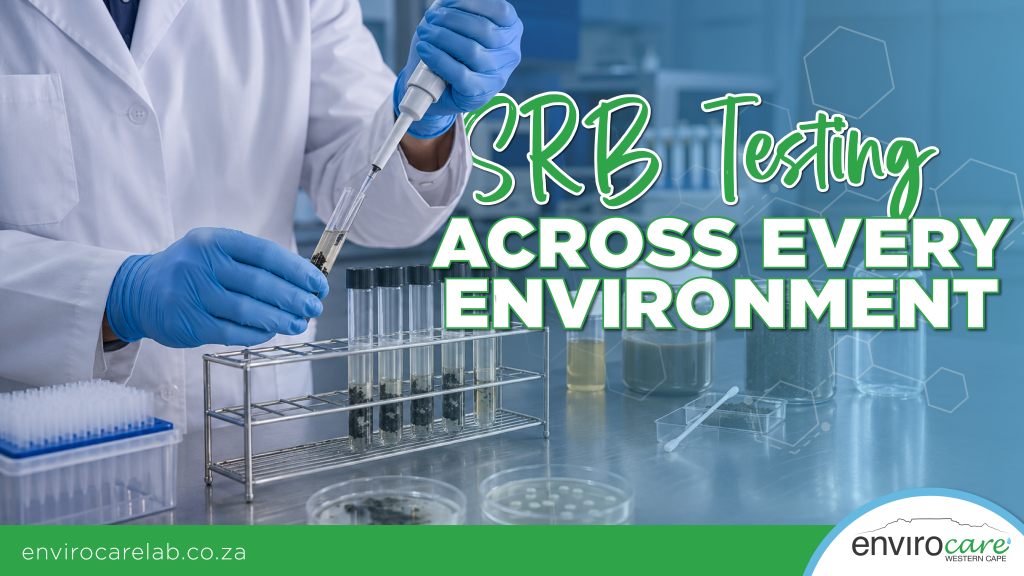
Sulphite-reducing bacteria testing is a specialised microbiological analysis used to investigate the presence of microorganisms capable of reducing sulphite under anaerobic conditions.
These organisms are relevant in environmental and microbiological monitoring because certain sulphite-reducing anaerobes can form resistant spores that persist in the environment. Their detection can provide useful information when investigating contamination, assessing environmental conditions and monitoring microbiological quality.
Understanding when sulphite-reducing bacteria analysis is appropriate can help businesses select relevant laboratory tests for their monitoring and quality assurance programmes.
What Are Sulphite-Reducing Bacteria?
Sulphite-reducing anaerobes are microorganisms capable of reducing sulphite to sulphide under anaerobic conditions. The group commonly associated with this type of analysis includes spore-forming bacteria from the genus Clostridium.
Their spores are particularly important in environmental microbiology because they can survive unfavourable environmental conditions for extended periods.
Unlike some other microbiological indicators, the presence of sulphite-reducing clostridia may provide information about contamination that occurred further in the past. Their persistence makes them relevant when investigating certain environmental and water quality concerns.
Why Is Sulphite-Reducing Bacteria Testing Important?
Sulphite-reducing bacteria analysis can contribute to microbiological investigations by providing information about the presence of specific anaerobic, spore-forming microorganisms.
Depending on the sample type and reason for testing, analysis may assist with:
- Environmental monitoring: Assessing the microbiological characteristics of selected environmental samples.
- Contamination investigations: Supporting investigations where persistent or historical contamination is suspected.
- Water quality assessments: Providing additional microbiological information where sulphite-reducing anaerobes are relevant to the investigation.
- Process monitoring: Supporting microbiological assessments of selected industrial and process samples.
- Quality assurance: Providing supplementary microbiological data for monitoring programmes.
The significance of a result depends on the sample source, testing method and the other microbiological information available. SRB analysis should therefore be selected according to the specific monitoring or investigation requirements.
When Should Sulphite-Reducing Bacteria Testing Be Considered?
Sulphite-reducing bacteria testing may be considered when an organisation requires additional information about anaerobic microorganisms in a particular sample.
Examples include:
- Investigating potential environmental contamination.
- Assessing selected water sources as part of a broader microbiological monitoring programme.
- Evaluating microbiological conditions in environmental samples.
- Supporting investigations involving soil, sediment or sludge.
- Monitoring selected industrial processes where anaerobic microorganisms are relevant.
Testing requirements will depend on the sample matrix and the objectives of the investigation.
Which Samples Can Be Analysed?
The suitability of a sample for sulphite-reducing bacteria analysis depends on the analytical method and the intended investigation.
Potential sample matrices may include:
Water Samples
Selected water samples may be submitted for sulphite-reducing anaerobe analysis as part of a broader microbiological assessment.
Soil, Sediment and Sludge
Environmental samples such as soil, sediment and sludge may be relevant when investigating the presence of persistent anaerobic microorganisms.
Industrial and Process Samples
Certain industrial samples may require specialised microbiological assessment depending on their composition and the conditions in which they are collected.
It is important to confirm sample suitability, collection requirements and handling conditions with the laboratory before submission.
Understanding Sulphite-Reducing Bacteria Test Results
Laboratory results provide information about the microorganisms detected or enumerated using the selected analytical method.
When interpreting results, it is important to consider:
- The original source and characteristics of the sample.
- The analytical method used.
- The reported microbial count or detection result.
- Applicable regulatory, customer or internal specifications.
- Other relevant microbiological results.
A positive result should be interpreted in the context of the investigation. It does not automatically establish the presence of a specific pathogen or indicate that a sample is unsafe.
Sulphite-Reducing Bacteria Testing at Envirocare Laboratory
Envirocare Laboratory provides specialised microbiological testing services to support environmental monitoring, quality assurance and contamination investigations.
Our microbiology department offers a range of analyses across different sample matrices, helping clients obtain relevant microbiological information for their operational and monitoring requirements.
If you are considering sulphite-reducing bacteria analysis, our team can assist with enquiries regarding sample suitability, submission requirements and the appropriate testing options.
Contact Envirocare Laboratory
Need assistance with Sulphite-Reducing Bacteria (SRB) analysis or other specialised microbiological testing?
Envirocare Laboratory offers microbiological testing services to support environmental monitoring, quality assurance and contamination investigations.
Contact your nearest Envirocare laboratory to discuss your testing requirements, sample submission procedures and available analyses.
Envirocare Laboratory – Potchefstroom
Telephone: +27 18 294 4283
Cell: +27 71 353 5740
Email: info@envirocarelab.co.za
Address: 6 Du Plooy Street, Potchefstroom, 2531
Envirocare Western Cape
Telephone: +27 82 343 9579
Telephone: +27 81 834 7198
Email: info_westerncape@envirocarelab.co.za
Address: PTF 18, Three Fountains Estate, R304, Philadelphia, Western Cape, 7304
Envirocare Laboratory – Your Partner in Compliance Success.
References
- American Public Health Association (APHA), American Water Works Association (AWWA) and Water Environment Federation (WEF). (2023). Standard Methods for the Examination of Water and Wastewater. 24th ed. Washington, DC: APHA.
- International Organization for Standardization (ISO). (1986). ISO 6461-2:1986 Water quality – Detection and enumeration of the spores of sulphite-reducing anaerobes (clostridia) – Part 2: Method by membrane filtration. Geneva: ISO.
- World Health Organization (WHO). (2022). Guidelines for Drinking-water Quality: Fourth Edition Incorporating the First and Second Addenda. Geneva: World Health Organization.
