

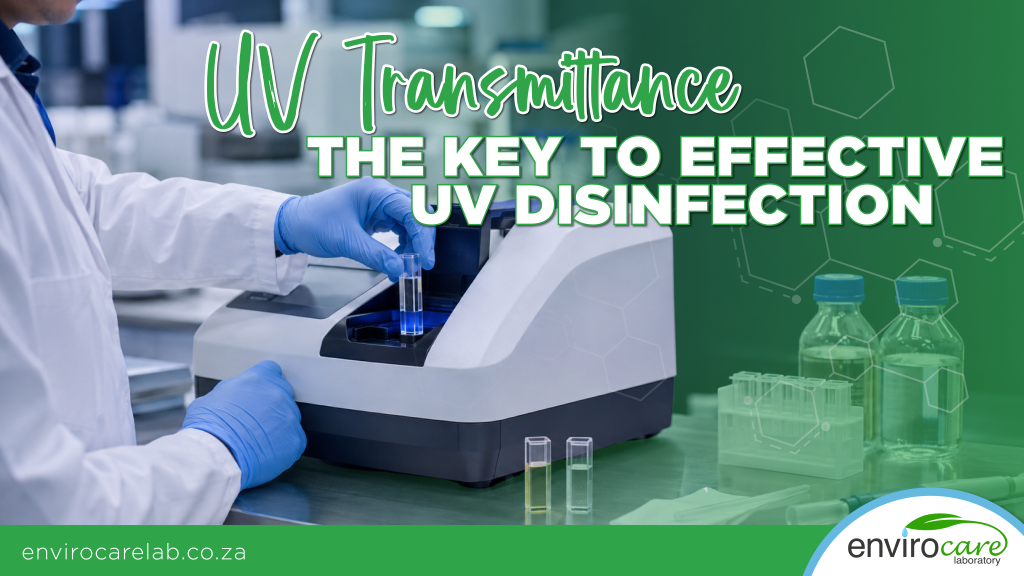
UV Transmittance (UVT) is one of the most important, but often overlooked, parameters for facilities that use ultraviolet (UV) disinfection in wastewater treatment.
While parameters such as Chemical Oxygen Demand (COD), Biological Oxygen Demand (BOD), Total Suspended Solids (TSS), and E. coli provide valuable information about water quality, UVT measures something entirely different: how effectively ultraviolet light can penetrate a water sample.
If UV light cannot pass through the water efficiently, UV disinfection systems may not deliver the required dose to inactivate microorganisms, even when the system itself is operating correctly.
This article explains what UV Transmittance is, how it is measured, what affects it, and why routine UVT testing is an important part of monitoring wastewater treatment performance.
What is UV Transmittance (UVT)?
UV Transmittance (UVT) is the percentage of ultraviolet light at 254 nanometres (254 nm) that passes through a water sample over a specified path length.
The measurement indicates how transparent the water is to UV light.
- High UVT means UV light passes through the water easily.
- Low UVT means substances within the water absorb or scatter UV light, reducing the amount of energy available for disinfection.
Unlike microbiological or chemical analyses, UVT is an optical measurement that helps predict how efficiently a UV disinfection system can perform.
Why is UV Transmittance Important?
Ultraviolet disinfection works by exposing microorganisms to UV light, damaging their DNA or RNA and preventing them from reproducing.
However, UV light must first travel through the water.
If the water contains excessive suspended solids, colour, or dissolved organic compounds, these substances can absorb or scatter UV light before it reaches microorganisms.
The result may be:
- Reduced UV disinfection efficiency
- Increased operating costs
- Poor treatment performance
- Higher risk of microorganisms surviving the treatment process
Routine UVT testing provides an early indication of changing water quality before treatment performance is affected.
How is UV Transmittance Measured?
UVT is measured by passing ultraviolet light at 254 nm through a water sample using specialised laboratory instrumentation.
The instrument compares the intensity of light entering the sample with the amount of light exiting the sample and reports the result as a percentage.
For example:
| UV Transmittance (%) | General Interpretation |
|---|---|
| Above 85% | Excellent UV penetration |
| 70–85% | Good UV penetration |
| Below 70% | Reduced UV penetration that may affect UV disinfection |
The acceptable UVT value depends on the design of the UV treatment system and its operational requirements.
What Causes Low UV Transmittance?
Several substances naturally reduce UV penetration in wastewater.
Common causes include:
- Suspended solids
- Natural organic matter
- Humic and fulvic acids
- Colour
- Iron and manganese
- Organic contaminants
- Fine particulate material
These materials either absorb ultraviolet light or scatter it away from microorganisms, reducing the effectiveness of UV treatment.
UV Transmittance vs Turbidity
Although they are often discussed together, UV Transmittance and turbidity measure different water quality characteristics.
Turbidity measures how cloudy water appears because of suspended particles.
UV Transmittance measures how much ultraviolet light passes through the sample.
A water sample may have relatively low turbidity but still have poor UV Transmittance because dissolved organic compounds absorb UV light.
For this reason, UVT and turbidity should be viewed as complementary measurements rather than interchangeable ones.
When Should UV Transmittance Be Tested?
Routine UVT testing is recommended wherever ultraviolet disinfection forms part of the treatment process.
This includes:
- Industrial wastewater treatment plants
- Food and beverage manufacturers
- Dairy processing facilities
- Pharmaceutical manufacturers
- Municipal wastewater treatment works
- Water recycling and reuse systems
- Beverage production facilities
Monitoring UVT helps operators identify changes in water quality that may influence UV system performance.
Can UV Transmittance Support Water Use Licence (WUL) Monitoring?
Depending on the treatment process and monitoring programme, UVT can provide valuable operational information alongside routine wastewater analyses.
For facilities operating under a Water Use Licence (WUL), UVT may be used to monitor the effectiveness of UV-based treatment processes and identify changes in effluent quality that could influence treatment performance.
UVT does not replace the parameters required by a Water Use Licence but serves as an additional performance indicator where UV disinfection is used.
UV Transmittance Testing at Envirocare Laboratory
Envirocare Laboratory provides UV Transmittance (UVT) testing as part of its comprehensive wastewater and environmental testing services.
Our experienced laboratory team delivers accurate analytical results to support treatment optimisation, operational monitoring, and environmental compliance.
Whether you operate an industrial wastewater treatment plant, municipal facility, or food manufacturing process using UV disinfection, our laboratory can help you better understand your water quality and treatment performance.
Contact Envirocare Laboratory
📞 Telephone: +27 (0)18 299 9400
📧 Email: info@envirocarelabs.com
🌐 Website: www.envirocarelabs.com
Your Partner in Compliance Success.
Learn More About Effluent Water Testing
UV Transmittance (UVT) is just one of many parameters that may be monitored to evaluate wastewater treatment performance. A comprehensive effluent monitoring programme often includes analyses such as Chemical Oxygen Demand (COD), Biological Oxygen Demand (BOD), Total Suspended Solids (TSS), pH, nutrients, microbiological testing, and other parameters required by your Water Use Licence (WUL).
To learn more about routine wastewater monitoring, regulatory requirements, and the full range of analyses available, read our article on Effluent Water Testing in South Africa.
References
- American Public Health Association (APHA), American Water Works Association (AWWA) & Water Environment Federation (WEF), 2023. Standard Methods for the Examination of Water and Wastewater. 24th ed. Washington, DC: American Public Health Association.
- Blatchley, E.R., Weng, S., Afifi, M.Z. and others, 2012. Ozone and UV254 radiation for municipal wastewater disinfection. Water Environment Research, 84(11), pp.2017–2027.
- Cantwell, R.E. and Hofmann, R., 2011. Ultraviolet absorption properties of suspended particulate matter in untreated surface waters. Water Research, 45(3), pp.1322–1328.
- Mezzanotte, V., Antonelli, M., Citterio, S. and Nurizzo, C., 2007. Wastewater disinfection alternatives: Chlorine, ozone, peracetic acid and UV light. Water Environment Research, 79(12), pp.2373–2379.
- United States Environmental Protection Agency (U.S. EPA), 2006. Ultraviolet Disinfection Guidance Manual for the Final Long Term 2 Enhanced Surface Water Treatment Rule (LT2ESWTR). EPA 815-R-06-007. Washington, DC: U.S. Environmental Protection Agency.
