

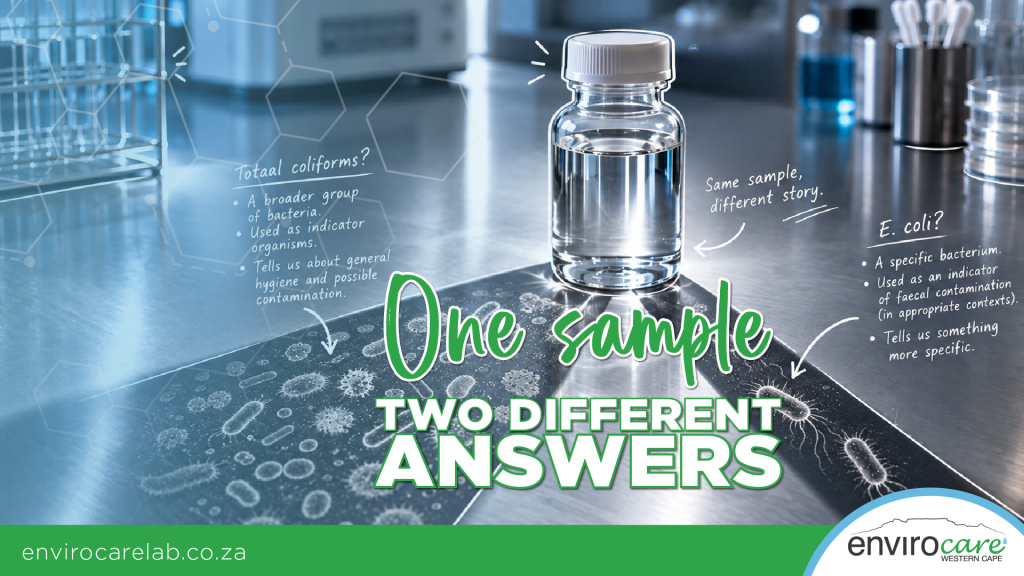
When water is submitted for microbiological testing, the laboratory report may include results for Total Coliforms, Faecal Coliforms and Escherichia coli (E. coli).
These three microbiological indicators are closely related, but they are not the same analysis and they do not provide exactly the same information.
Understanding the difference can help businesses interpret their water microbiology results, investigate potential contamination and select appropriate microbiological analyses for their water-monitoring programmes.
Why Are Coliforms Tested in Water?
Microbiological contamination cannot always be identified by looking at water.
Water may appear clear and have no unusual taste or odour while still containing microorganisms.
For this reason, laboratory microbiological water testing can be used to investigate indicator organisms that provide information about the sanitary and microbiological condition of a water sample.
Among the commonly requested microbiological analyses are:
- Total Coliforms
- Faecal Coliforms
- E. coli
Although they are often discussed together, each test has a different purpose.
What Are Total Coliforms in Water?
Total Coliforms are a broad group of bacteria used as microbiological indicator organisms.
Coliform bacteria can occur in environmental sources such as soil and vegetation, as well as in faecal material. Therefore, the detection of Total Coliforms does not automatically mean that faecal contamination has occurred.
Total Coliform testing can provide useful information about the general microbiological condition of a water system.
For example, an unexpected Total Coliform result may prompt a business to investigate:
- Water treatment processes
- Storage tanks
- Distribution systems
- Sanitation practices
- Environmental contamination
- Changes in water quality
- Possible contamination of the water system
The World Health Organization identifies Total Coliforms as an indicator that can be useful for monitoring the cleanliness and integrity of distribution systems.
Why test for Total Coliforms?
Total Coliform testing can be useful when the objective is to monitor general microbiological and sanitary conditions rather than specifically determine whether faecal contamination has occurred.
A Total Coliform-positive result should therefore be interpreted in context.
Total Coliforms do not automatically mean E. coli is present.
What Are Faecal Coliforms in Water?
Faecal Coliforms are a group of coliform bacteria more closely associated with faecal contamination.
The term thermotolerant coliforms is also used in water microbiology. The two terms are closely related, although they should not simply be assumed to represent exactly the same organisms in every testing method.
Faecal Coliform testing can provide an indication of possible faecal contamination in a water sample.
South African Department of Water and Sanitation information describes Faecal Coliforms as an indicator of possible disease-causing organisms and a sign of faecal contamination.
However, Faecal Coliforms should not simply be treated as another name for E. coli.
The Faecal Coliform group can include organisms other than E. coli.
Why test for Faecal Coliforms?
Depending on the water type, testing objective and applicable requirements, Faecal Coliform analysis may be used when investigating possible faecal contamination.
It can provide different information from a Total Coliform result and can therefore be useful within a broader microbiological water-testing programme.
What Is E. coli in Water?
Escherichia coli (E. coli) is a specific bacterial species commonly found in the intestinal tract of humans and other warm-blooded animals.
Because E. coli is closely associated with faecal material, it is widely used as an indicator of faecal contamination in water.
The World Health Organization identifies E. coli as the most suitable indicator of faecal contamination and notes that thermotolerant coliforms can be used as an alternative in appropriate circumstances.
South African Department of Water and Sanitation information also identifies E. coli as an indicator whose presence in water suggests faecal contamination.
Why test for E. coli?
E. coli testing provides a more specific indication of possible faecal contamination than Total Coliform testing.
Where E. coli is detected in water intended for drinking, the result is particularly important and should be assessed against the applicable requirements.
Total Coliforms vs Faecal Coliforms vs E. coli
The simplest way to understand the difference is to look at what each indicator is generally used to tell us.
| Test | What is being measured? | What does it generally indicate? |
|---|---|---|
| Total Coliforms | A broad group of coliform bacteria | General microbiological or sanitary conditions |
| Faecal Coliforms | A group of thermotolerant coliform bacteria | Possible faecal contamination |
| E. coli | A specific bacterial species | More specific indication of faecal contamination |
The important takeaway:
Total Coliforms ≠ Faecal Coliforms ≠ E. coli
They are related indicators, but they are not interchangeable laboratory tests.
What Is the Difference Between Total Coliforms and E. coli?
This is one of the most common questions when interpreting water microbiology results.
Total Coliforms are a broad indicator group.
E. coli is a specific bacterial species associated with faecal contamination.
Therefore, detecting Total Coliforms does not automatically mean that E. coli has been detected.
A water sample can have Total Coliforms detected while E. coli is not detected.
This distinction is important because the two results can have different implications when assessing the microbiological condition of a water system.
What Is the Difference Between Faecal Coliforms and E. coli?
Faecal Coliforms represent a group of bacteria, whereas E. coli is a specific bacterial species.
E. coli is included within the broader group of thermotolerant/faecal-associated coliforms, but not every organism detected by a Faecal Coliform analysis is necessarily E. coli.
WHO notes that thermotolerant coliforms other than E. coli can include environmental organisms, which is one reason E. coli is considered the more precise indicator of faecal pollution.
Therefore:
Faecal Coliform result ≠ automatically an E. coli result.
Why Test for Total Coliforms and E. coli?
A business may ask:
“If E. coli is the more specific indicator of faecal contamination, why test for Total Coliforms as well?”
The answer is that the two tests can provide different information.
Total Coliform testing can provide information about broader microbiological and sanitary conditions within a water system.
E. coli testing provides a more specific indication of possible faecal contamination.
Looking at the results together can therefore provide useful context when investigating the microbiological condition of water.
For example:
Total Coliforms detected, E. coli not detected
This indicates that Total Coliform bacteria were detected in the sample, but E. coli was not detected by the analysis.
This does not automatically indicate faecal contamination.
The result should be interpreted according to the water source, intended use and applicable requirements.
Total Coliforms detected, E. coli detected
This provides a different picture because E. coli has been detected.
For water applications where microbiological safety is important, further investigation may be required according to the relevant requirements and risk-management procedures.
Neither detected
This means that the organisms tested for were not detected under the conditions of the particular analysis.
It should not be interpreted as meaning that no microorganisms whatsoever are present in the water.
Why Does the Choice of Water Microbiology Test Matter?
Not every microbiological water test answers the same question.
Consider the difference between these two questions:
“Has the general microbiological condition of the water changed?”
and
“Is there evidence of faecal contamination?”
These questions may require different indicators.
Total Coliforms can provide broader information about microbiological and sanitary conditions, while E. coli is more specifically associated with faecal contamination.
This is why selecting the appropriate analysis is an important part of a water-monitoring programme.
When Might Coliform and E. coli Testing Be Used?
Microbiological analysis for Total Coliforms, Faecal Coliforms and E. coli may form part of water-monitoring programmes for different applications.
Depending on the specific requirements, testing may be relevant to:
- Potable water
- Borehole water
- Raw water
- Surface water
- Stored water
- Process-related water
- Water used in business operations
- Other water samples requiring microbiological assessment
The exact testing requirements should be determined according to the type of water, intended use, potential risks and applicable standards or specifications.
Envirocare’s current microbiology scope includes water matrices such as raw, potable and effluent water, with testing for Total Coliforms, E. coli and Faecal Coliforms.
What Can Cause Coliforms to Be Detected in Water?
Coliform bacteria may enter or be detected in water for a number of reasons.
Potential factors can include:
- Environmental contamination
- Source-water contamination
- Inadequate sanitation
- Problems with water treatment
- Contamination of storage tanks
- Distribution-system issues
- Cross-contamination
- Damage or maintenance affecting the water system
- Poor sampling practices
The significance of a result depends on the specific organism detected and the circumstances surrounding the sample.
Why Water Sampling and Handling Matter
Accurate microbiological testing depends on more than the laboratory analysis itself.
The sample must be representative of the water being investigated and handled appropriately before it reaches the laboratory.
Factors such as:
- Sample collection
- Sample container
- Sample storage
- Temperature during transport
- Time between collection and analysis
- Sample integrity
can affect the quality of the sample and potentially influence the result.
Envirocare’s current microbiology submission information specifies that water samples should be kept in a cooler box during transport and delivered within 24 hours, with a minimum water sample volume of 200 mL for its listed analyses.
Always follow the laboratory’s current sampling and submission requirements for the analysis requested.
Choosing the Appropriate Water Microbiology Analysis
There is no single microbiological indicator that answers every water-quality question.
The appropriate test depends on what you need to determine.
For example:
Total Coliforms
Useful for broader microbiological and sanitary monitoring.
Faecal Coliforms
Useful as an indicator of possible faecal contamination, depending on the application and method.
E. coli
A more specific indicator of faecal contamination.
In some situations, testing more than one indicator can provide additional information.
The appropriate testing programme should therefore be based on the water source, intended use, risk assessment and applicable requirements.
Microbiological Water Testing at Envirocare Laboratory
At Envirocare Laboratory, we provide applicable microbiological analysis for water samples, including Total Coliforms, Faecal Coliforms and E. coli.
Our microbiology laboratory works with water matrices including raw, potable and effluent water, as reflected in our current accreditation schedule.
Our microbiology services can assist businesses with:
- Routine microbiological monitoring
- Investigation of unexpected results
- Monitoring of water systems
- Contamination investigations
- Quality-control programmes
- Applicable compliance testing
The right test depends on what you need the analysis to tell you.
Need Total Coliform, Faecal Coliform or E. coli Testing?
Don’t assume that all coliform results mean the same thing.
Total Coliforms, Faecal Coliforms and E. coli provide different information—and understanding the difference can help you choose the appropriate microbiological analysis for your water-monitoring programme.
Contact Envirocare Laboratory to discuss your water microbiology testing requirements.
Envirocare Laboratory
Address: 6 Du Plooy Street, Potchefstroom, South Africa
Tel: 018 297 1261
Email: info@envirocarelab.co.za
Envirocare Western Cape Laboratory
Address: PTF 18, Three Fountains Estate, R304, Philadelphia, Western Cape, South Africa
Tel: 021 972 1584
Email: info_westerncape@envirocarelab.co.za
References
- World Health Organization (WHO). Guidelines for Drinking-water Quality: Fourth Edition Incorporating the First and Second Addenda. Geneva: World Health Organization; 2022.
- World Health Organization (WHO). Guidelines for Drinking-water Quality – Chapter 7: Microbial Aspects. WHO. This guidance covers the use of E. coli, thermotolerant coliforms and Total Coliforms as microbiological indicators.
- World Health Organization (WHO). Guidelines for Drinking-water Quality – Table 7.10: Guideline Values for Verification of Microbial Quality. This provides guidance on E. coli/thermotolerant coliforms in drinking-water verification.
- United States Environmental Protection Agency (US EPA). Revised Total Coliform Rule and Total Coliform Rule. The EPA describes Total Coliforms as indicators useful for assessing treatment adequacy and distribution-system integrity, and distinguishes them from E. coli and faecal coliforms.
- United States Environmental Protection Agency (US EPA). Distribution System Indicators of Drinking Water Quality. This resource discusses Total Coliforms, Faecal Coliforms and E. coli among microbial indicators used in assessing drinking-water distribution systems
