

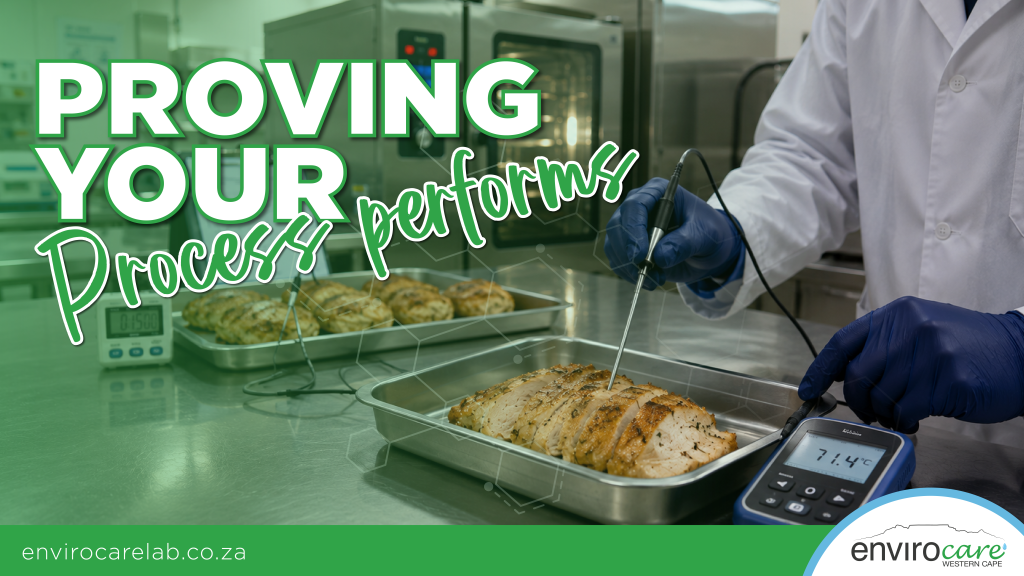
Food safety begins long before a product reaches the consumer. Every stage of food production plays an important role, but few are as critical as the cooking process. Cooking not only develops flavour, texture, and appearance, it is also one of the most effective methods of controlling harmful microorganisms that can cause foodborne illness.
At Envirocare Western Cape, we help food manufacturers verify and validate their cooking processes using scientific evidence, ensuring products are consistently safe, compliant, and of the highest quality.
Why Is Cooking Validation Important?
Many food products rely on cooking as their primary method of eliminating or significantly reducing harmful microorganisms such as Salmonella spp., Listeria monocytogenes, Escherichia coli, and Campylobacter spp.
However, every product is different. Factors such as product composition, size, moisture content, packaging, equipment, and cooking methods all influence how effectively heat penetrates the product.
A cooking process that works for one product may not be sufficient for another.
This is why food manufacturers cannot simply rely on recommended temperatures, they need scientific evidence demonstrating that their specific process consistently achieves the required level of microbial reduction.
Understanding the Difference Between Validation and Verification
Although the terms are often used together, validation and verification serve different purposes.
Cooking Validation
Validation is the scientific process of demonstrating that a cooking procedure is capable of achieving the desired food safety outcome under normal production conditions.
Validation studies are commonly required when:
- Developing a new product.
- Introducing new production equipment.
- Modifying recipes or ingredients.
- Changing cooking parameters.
- Implementing or updating a HACCP plan.
- Meeting customer or retailer requirements.
Cooking Verification
Verification ensures that the validated cooking process continues to perform effectively during routine production.
Verification activities may include:
- Reviewing cooking temperatures and holding times.
- Monitoring Critical Control Points (CCPs).
- Calibration of temperature monitoring equipment.
- Routine microbiological testing.
- Internal audits and process reviews.
- Verification of production records.
In simple terms:
Validation proves the process works. Verification confirms it continues to work every day.
The Benefits of Cooking Verification and Validation
Implementing scientifically supported cooking studies offers significant benefits to food manufacturers.
Improved Food Safety
Proper validation confirms that cooking processes effectively reduce harmful microorganisms to safe levels, helping protect consumers from foodborne illness.
Regulatory Compliance
Validation supports compliance with:
- HACCP principles
- ISO 22000 Food Safety Management Systems
- FSSC 22000
- Retailer food safety requirements
- Customer specifications
- Regulatory expectations
Reduced Business Risk
Scientific validation reduces the likelihood of:
- Product recalls
- Customer complaints
- Food safety incidents
- Brand damage
- Regulatory non-compliance
Increased Customer Confidence
Retailers and customers increasingly expect documented evidence that food safety controls are scientifically validated.
Providing this evidence demonstrates a commitment to quality and builds confidence in your products.
How Envirocare Laboratory Western Cape Can Assist
At Envirocare Laboratory Western Cape, we work closely with food manufacturers to develop cooking verification and validation studies tailored to their products and production processes.
Our experienced microbiology team can assist with:
- Cooking validation studies
- Cooking verification programmes
- Microbiological analysis before and after cooking
- Target organism verification
- Challenge study support where appropriate
- HACCP verification support
- Shelf-life investigations linked to cooking processes
- Product quality assessments
Every validation study is designed around the client’s specific product, processing conditions, and food safety objectives.
Industries We Support
Our cooking verification and validation services are suitable for a wide range of food sectors, including:
- Poultry processing
- Meat products
- Ready-to-eat meals
- Seafood
- Dairy products
- Plant-based foods
- Catering operations
- Food manufacturing facilities
- Export food producers
Whether you manufacture fresh, chilled, frozen, or cooked products, scientific process validation helps ensure consistent food safety.
Why Choose Envirocare Laboratory Western Cape?
At Envirocare Laboratory Western Cape, we understand that food safety is built on reliable science.
As an ISO/IEC 17025:2017 accredited laboratory, we are committed to providing accurate, reliable, and scientifically sound testing services that support our clients’ quality assurance programmes.
Our team combines microbiological expertise with practical industry knowledge to help manufacturers validate processes, strengthen HACCP systems, and maintain compliance with industry standards.
Partner with Envirocare Western Cape
Food safety is more than meeting regulatory requirements—it’s about protecting consumers, safeguarding your brand, and ensuring confidence in every product you manufacture.
Whether you are launching a new product, reviewing an existing cooking process, or strengthening your food safety management system, Envirocare Laboratory Western Cape can provide the scientific support you need.
Contact Envirocare Western Cape
📞 +27 82 343 9579 | +27 81 834 7198
✉️ info_westerncape@envirocarelab.co.za
References
- Codex Alimentarius Commission. (2022). General Principles of Food Hygiene (CXC 1-1969): Annex – Hazard Analysis and Critical Control Point (HACCP) System and Guidelines for its Application.
- International Organization for Standardization (ISO). (2018). ISO 22000:2018 – Food Safety Management Systems – Requirements for Any Organization in the Food Chain.
- U.S. Food and Drug Administration (FDA). Food Code (latest edition). Guidance on safe cooking temperatures and time/temperature controls for food safety.
- U.S. Department of Agriculture (USDA) Food Safety and Inspection Service (FSIS). Appendix A: Compliance Guidelines for Meeting Lethality Performance Standards for Certain Meat and Poultry Products.
