

Food safety is a fundamental responsibility for every food manufacturer, processor, retailer, and environmental monitoring programme. Identifying harmful pathogens before they reach consumers is essential for protecting public health, maintaining regulatory compliance, and safeguarding brand reputation.
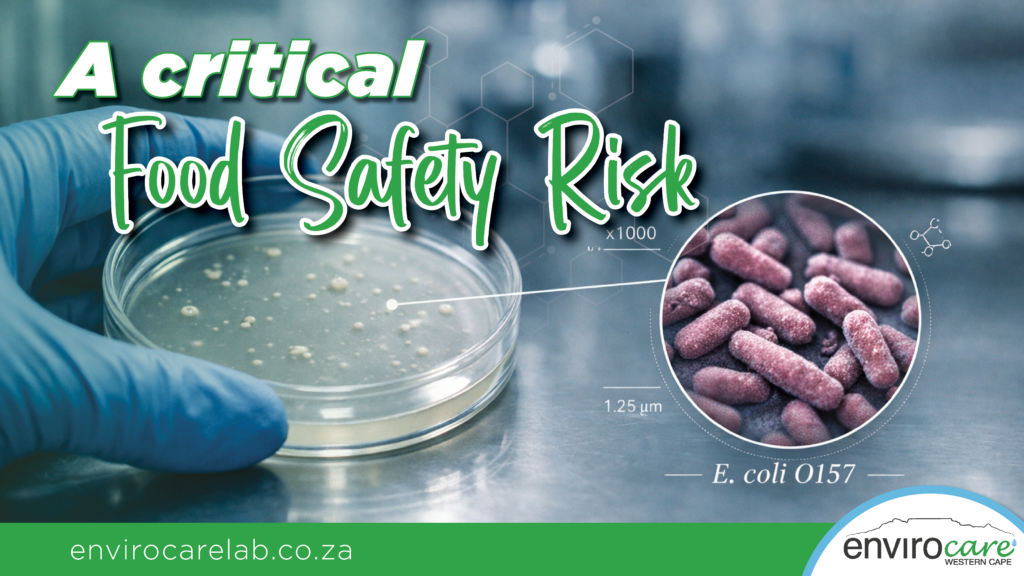
Among the most significant foodborne pathogens is Escherichia coli O157, a Shiga toxin-producing strain of Escherichia coli (STEC) capable of causing severe illness, even when present in very low numbers. Because of its low infectious dose and potential health impacts, accurate laboratory detection is a critical component of modern food safety systems.
At Envirocare Western Cape, we are expanding our microbiological testing capabilities through the introduction of E. coli O157 screening, with SANAS accreditation currently in progress. This service provides food manufacturers with reliable screening supported by confirmatory testing through our SANAS-accredited sister laboratory in Potchefstroom.
What Is Escherichia coli O157?
Escherichia coli (E. coli) is a diverse group of bacteria naturally found in the intestines of humans and warm-blooded animals. While most strains are harmless and form part of the normal intestinal microbiota, certain strains have acquired virulence factors that enable them to cause disease.
One of the most important pathogenic strains is E. coli O157, which belongs to the group known as Shiga toxin-producing Escherichia coli (STEC). These bacteria produce potent Shiga toxins that can damage the lining of the intestine and, in severe cases, affect the kidneys.
Infection may result in symptoms including:
- Severe abdominal cramps
- Bloody diarrhoea
- Vomiting
- Fever (less common)
- Haemolytic uraemic syndrome (HUS), a serious complication that can lead to kidney failure, particularly in young children, older adults, and immunocompromised individuals
Because infection can occur after exposure to only a small number of bacterial cells, preventing contamination and ensuring rapid detection are essential.
Where Can E. coli O157 Be Found?
E. coli O157 has been associated with a wide range of food and environmental sources, including:
- Raw and undercooked beef
- Raw milk and unpasteurised dairy products
- Fresh produce and leafy vegetables
- Water supplies
- Food processing environments
- Animal faeces and agricultural runoff
Cross-contamination during food production or processing remains one of the primary routes through which the organism enters the food chain.
Why Is E. coli O157 Testing Challenging?
Reliable detection requires more than routine microbiological testing.
The organism may be present in extremely low concentrations or become stressed during food processing or environmental exposure, making recovery more difficult. Furthermore, pathogenic E. coli O157 must be distinguished from the many harmless E. coli strains commonly present in environmental and food samples.
For these reasons, internationally recognised testing protocols employ selective enrichment, screening, and confirmatory methods to maximise both sensitivity and specificity.
Envirocare Western Cape’s E. coli O157 Screening Service
To support food manufacturers with rapid and dependable pathogen detection, Envirocare Western Cape is implementing an enhanced E. coli O157 screening service, with SANAS accreditation currently underway.
The screening process is designed to:
- Confidently identify negative samples during routine monitoring
- Detect presumptive positive samples requiring further investigation
- Support proactive food safety management
- Reduce uncertainty during routine microbiological surveillance
Early identification allows businesses to investigate potential contamination before products reach the market.
Confirmatory Testing for Greater Confidence
Samples identified as presumptive positive undergo confirmatory testing through Envirocare Laboratory’s SANAS-accredited laboratory in Potchefstroom using a validated ELISA-based detection method.
This two-stage testing approach provides several important advantages:
- Improved confidence through independent confirmation
- Reduced likelihood of false-positive reporting
- Defensible laboratory results suitable for customer audits and regulatory requirements
- Increased confidence when making food safety decisions
Combining rapid screening with validated confirmation helps ensure accurate and reliable pathogen detection.
Why Accurate E. coli O157 Testing Matters
Foodborne pathogen testing is an essential part of every effective food safety management system.
Routine monitoring helps businesses:
- Verify HACCP and food safety programmes
- Detect contamination before products reach consumers
- Reduce the likelihood of costly product recalls
- Demonstrate compliance with customer and regulatory requirements
- Protect brand reputation and consumer confidence
- Support export and retailer quality assurance programmes
For businesses operating in highly regulated food industries, laboratory testing provides valuable scientific evidence that food safety controls remain effective.
Industries That Benefit from E. coli O157 Testing
Routine testing is valuable across numerous industries, including:
- Meat and poultry processors
- Dairy manufacturers
- Fresh produce growers and packhouses
- Ready-to-eat food manufacturers
- Beverage and bottled water producers
- Food ingredient suppliers
- Hospitality and catering operations
- Environmental monitoring programmes
Contact Envirocare Western Cape
For more information about E. coli O157 testing, microbiological analysis, or sample submissions, contact:
Envirocare Laboratory (Pty) Ltd – Western Cape
PTF 18, Three Fountains Estate, R304, Philadelphia, Western Cape, 7304
Email: info_westerncape@envirocarelab.co.za
Tel: +27 82 343 9579 | +27 81 834 7198
References
- Centers for Disease Control and Prevention (CDC). 2024. E. coli (Escherichia coli). https://www.cdc.gov/ecoli/
- European Food Safety Authority (EFSA). 2024. The European Union One Health Zoonoses Report.
- Food and Agriculture Organization of the United Nations (FAO) & World Health Organization (WHO). 2018. Shiga toxin-producing Escherichia coli (STEC) and food: Attribution, Characterization and Monitoring.
- Feng, P., Weagant, S.D. & Grant, M.A. 2020. Bacteriological Analytical Manual (BAM): Detection of Escherichia coli O157. U.S. Food and Drug Administration.
- International Organization for Standardization. 2017. ISO 16654: Microbiology of the Food Chain — Horizontal Method for the Detection of Escherichia coli O157.
- U.S. Food and Drug Administration (FDA). 2022. Bad Bug Book: Foodborne Pathogenic Microorganisms and Natural Toxins Handbook.
- World Health Organization (WHO). 2023. E. coli Fact Sheet.
