


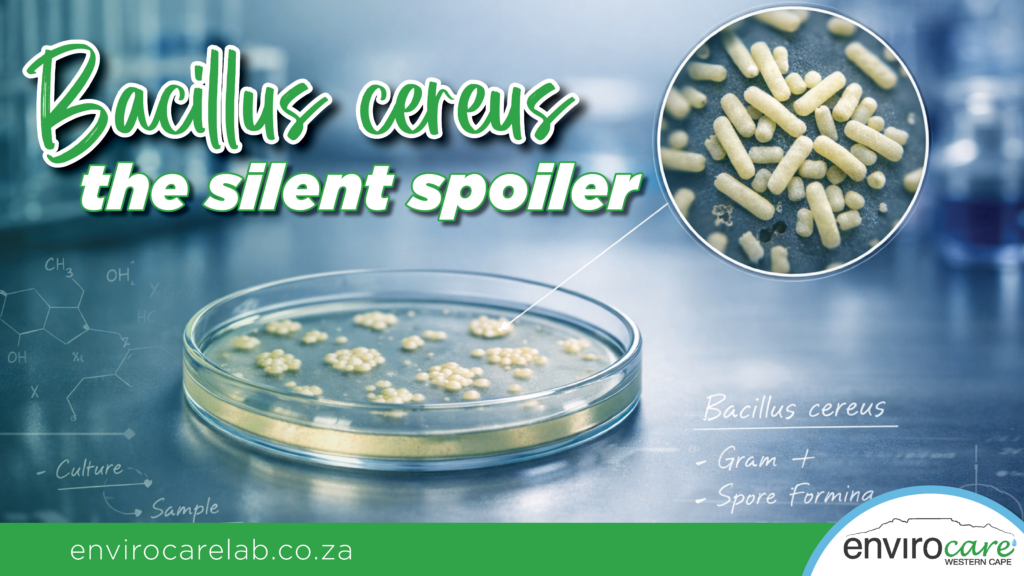
Food safety depends on more than eliminating obvious contaminants. Some microorganisms can survive food processing, remain undetected during production, and only become problematic when conditions allow them to grow. One such organism is Bacillus cereus, a spore-forming bacterium that is recognised worldwide as both a cause of food spoilage and foodborne illness.
For food manufacturers, processors and quality assurance teams, understanding and monitoring Bacillus cereus is an essential part of producing safe, high-quality products.
What is Bacillus cereus?
Bacillus cereus is a naturally occurring bacterium commonly found in soil, dust, water, vegetation and agricultural environments. Because it is widespread in nature, it can easily enter the food production chain through raw materials, equipment or environmental contamination.
Unlike many other bacteria, Bacillus cereus produces heat-resistant spores. While the actively growing bacterial cells are destroyed during normal cooking, these spores can survive heat treatments such as cooking and, in some cases, pasteurisation. If cooked food is cooled too slowly or stored at inappropriate temperatures, the spores can germinate, allowing the bacteria to multiply rapidly.
Some strains are capable of producing toxins that cause foodborne illness, making prevention and routine microbiological monitoring essential.
Foods Commonly Associated with Bacillus cereus
Although Bacillus cereus can contaminate many food products, it is most frequently associated with:
- Cooked rice and rice dishes
- Pasta and noodles
- Cereals and grains
- Starchy foods
- Herbs and spices
- Dairy products
- Sauces and soups
- Ready-to-eat meals
- Vegetables
Because spores are naturally present in many raw ingredients, proper cooking alone cannot always eliminate the risk. Effective cooling, storage and hygiene practices remain critical control measures.
How Does Bacillus cereus Cause Food Poisoning?
Foodborne illness caused by Bacillus cereus generally occurs in two forms.
Emetic (Vomiting) Syndrome
The emetic form results from a heat-stable toxin that is produced in food before it is consumed. Once this toxin has formed, reheating the food will not destroy it.
Symptoms typically include:
- Nausea
- Vomiting
- Abdominal discomfort
These symptoms usually develop within 0.5 to 6 hours after consumption.
Diarrhoeal Syndrome
The diarrhoeal form occurs when viable bacteria are ingested and produce toxins within the small intestine.
Common symptoms include:
- Diarrhoea
- Abdominal cramps
- Occasionally nausea
Symptoms generally develop between 6 and 15 hours after eating contaminated food.
While illness is often self-limiting in healthy individuals, severe cases may occur in vulnerable populations, including young children, older adults and immunocompromised individuals.
Why Laboratory Testing Matters
Because Bacillus cereus spores are commonly found in the environment, prevention relies on effective food safety systems supported by routine microbiological testing.
Laboratory testing helps food manufacturers:
- Detect Bacillus cereus contamination in raw materials and finished products.
- Monitor environmental hygiene programmes.
- Verify cleaning and sanitation effectiveness.
- Support shelf-life studies and product validation.
- Investigate contamination trends before they become food safety incidents.
- Demonstrate compliance with customer specifications and food safety management systems.
Routine microbiological monitoring provides valuable data that enables businesses to identify risks early and implement corrective actions before product quality or consumer safety is compromised.
How Envirocare Can Help
At Envirocare Western Cape, we provide accurate detection and enumeration of Bacillus cereus as part of our comprehensive microbiological testing services for the food industry.
Our ISO/IEC 17025:2017 SANAS-accredited laboratory supports food manufacturers with reliable analytical results that assist in:
- Routine product testing
- Environmental and hygiene monitoring
- Shelf-life validation
- Food safety investigations
- Quality assurance programmes
By providing dependable microbiological data, we help businesses make informed decisions that protect product quality, support regulatory compliance and strengthen consumer confidence.
A Proactive Approach to Food Safety
Managing Bacillus cereus is about more than responding to contamination—it is about preventing it.
Combining good manufacturing practices, effective temperature control, environmental hygiene and routine laboratory testing allows food producers to minimise the risk of bacterial growth and toxin production while maintaining consistent product quality.
Whether you manufacture ready-to-eat meals, dairy products, cereals, sauces or other food products, routine microbiological testing is an important component of a robust food safety management system.
Partner with Envirocare Western Cape for trusted laboratory testing that helps you identify risks early, maintain compliance and deliver safe, high-quality food products with confidence.
Contact Envirocare Laboratory
Potchefstroom
📞 Tel: +27 18 294 4283
📱 Cell: +27 71 353 5740
Western Cape
📧 info_westerncape@envirocarelab.co.za
📞 +27 82 343 9579
📞 +27 81 834 7198
References
- European Food Safety Authority (EFSA). (2016). Risks for public health related to the presence of Bacillus cereus and other Bacillus spp. including Bacillus thuringiensis in foodstuffs. EFSA Journal, 14(7), 4524.
- U.S. Food and Drug Administration. (2022). Bad Bug Book: Foodborne Pathogenic Microorganisms and Natural Toxins Handbook – Bacillus cereus.
- Centers for Disease Control and Prevention (CDC). Bacillus cereus and Other Bacillus Species. Available at: https://www.cdc.gov/foodborne-outbreaks/about/bacillus-cereus.html
- International Commission on Microbiological Specifications for Foods (ICMSF). (2005). Microorganisms in Foods 6: Microbial Ecology of Food Commodities. 2nd Edition. Springer.
- Food and Agriculture Organization of the United Nations (FAO) & World Health Organization (WHO). Microbiological Risk Assessment Series.
