

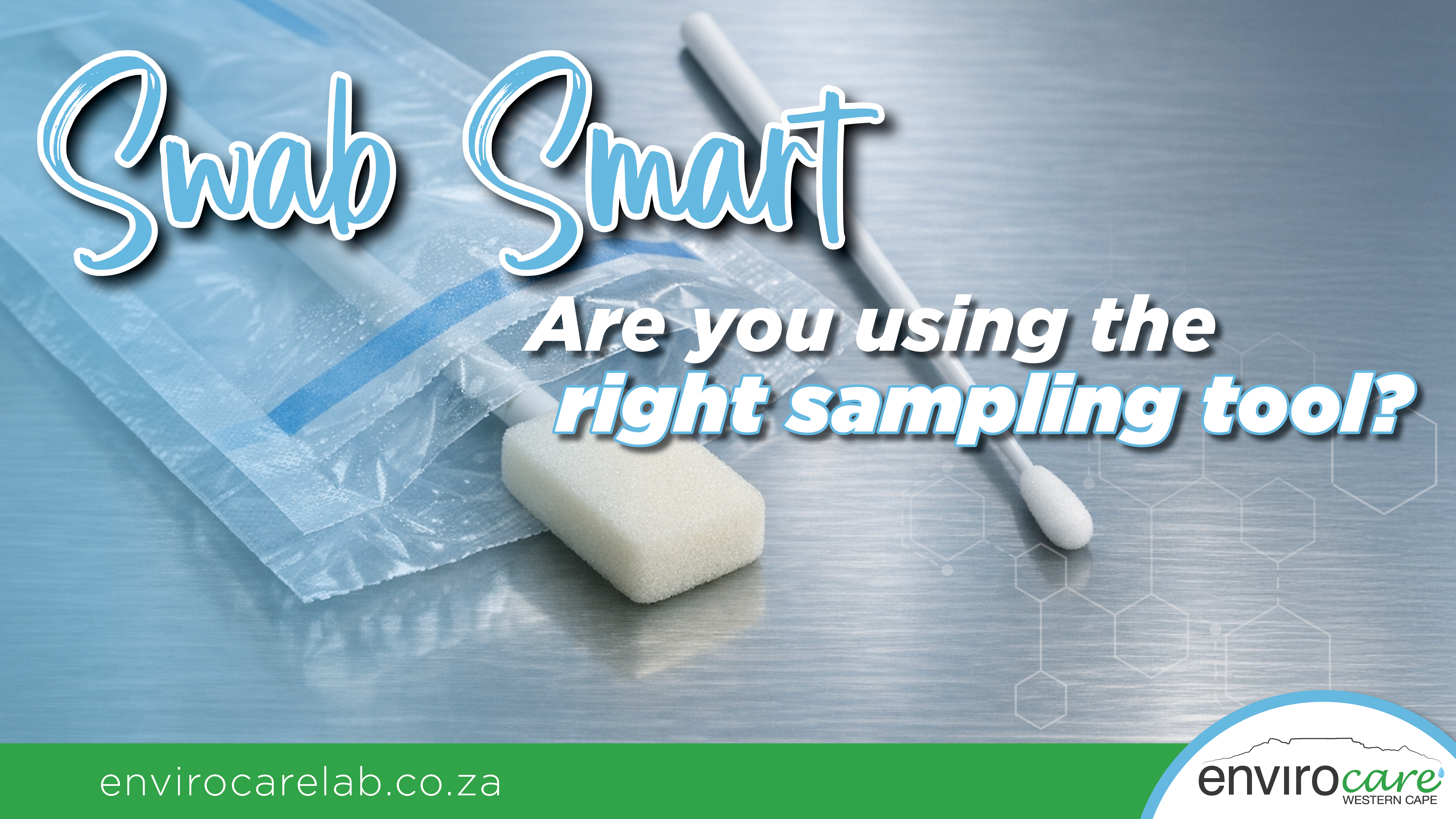
In environmental monitoring, accuracy starts long before results reach the laboratory. One of the most overlooked, yet critical, factors influencing microbial detection is the type of sampling tool used.
At Envirocare Western Cape, we regularly support clients in strengthening their environmental monitoring programmes. A common observation is the use of standard tip swabs for all applications, including pathogen detection such as Listeria monocytogenes. While these swabs are highly effective in specific scenarios, they are not always the most appropriate choice for every sampling need.
Understanding the Role of Sampling Tools
Effective environmental monitoring is about more than just collecting a sample, it’s about collecting a representative sample. The choice between a standard swab and a sponge swab can significantly influence organism recovery, particularly when targeting low-level contamination in food production environments.
Standard Swabs: Precision Sampling
Standard tip swabs are designed for targeted, precise sampling and offer several advantages:
- Ideal for small or defined sampling points
- Effective for routine hygiene verification
- Suitable for narrow, hard-to-reach, or intricate surfaces
These swabs are commonly used for spot checks, equipment crevices, and areas where access is limited. They remain a valuable tool in any monitoring programme, especially where precision is required.
Sponge Swabs: Maximising Coverage
For larger surface areas, sponge swabs provide a more comprehensive sampling approach:
- Cover significantly larger surface areas in a single sample
- Typically pre-moistened with buffered solutions to improve microbial recovery
- Well-suited for floors, drains, walls, and large equipment surfaces
When monitoring for pathogens such as Listeria monocytogenes, sponge swabs can greatly improve detection sensitivity. Their ability to collect material from a broader area increases the likelihood of identifying contamination that may otherwise go unnoticed.
Why the Right Choice Matters
Inadequate sampling, particularly under-sampling, can lead to false-negative results and a misleading sense of security. In high-risk environments such as food production facilities, this can have serious implications for product safety, regulatory compliance, and brand reputation.
By selecting the appropriate sampling device for each application, businesses can:
- Improve detection of environmental pathogens
- Strengthen food safety systems
- Support compliance with industry standards and audits
- Enhance overall risk management strategies
A Practical Training Insight
A key principle we emphasise during client support and training is simple:
“Sample smarter, not just more.”
Using the correct tool for the right surface ensures that your environmental monitoring programme delivers meaningful, reliable data, not just results.
Partnering with Envirocare Western Cape
Choosing the right sampling strategy doesn’t have to be complicated. Our team is available to guide you in selecting the most suitable tools and approaches for your specific testing requirements.
Whether you are refining your current programme or building one from the ground up, we are here to support your commitment to food safety excellence.
📍 Three Fountains Estate, R304, Philadelphia, Western Cape
📧 info_westerncape@envirocarelab.co.za
📞 +27 82 343 9579
References
- International Organization for Standardization. (2017). ISO 18593: Microbiology of the food chain — Horizontal methods for surface sampling.
- Food and Agriculture Organization & World Health Organization. (2009). Microbiological hazards in fresh leafy vegetables and herbs.
- U.S. Food and Drug Administration. (2017). Control of Listeria monocytogenes in Ready-To-Eat Foods: Guidance for Industry.
- United States Department of Agriculture Food Safety and Inspection Service. (2014). FSIS Environmental Sampling Program for Listeria monocytogenes.
- Health Canada. (2012). Environmental Sampling for Listeria monocytogenes in Food Processing Areas.
- Moore, G., & Griffith, C. (2007). Problems associated with traditional hygiene swabbing: the need for in-house standardization. Journal of Applied Microbiology.
- Davidson, C. A., Griffith, C. J., Peters, A. C., & Fielding, L. M. (1999). Evaluation of two methods for monitoring surface cleanliness — ATP bioluminescence and traditional hygiene swabbing.
