

Salmonella remains one of the most persistent and costly microbiological hazards affecting the food, animal feed, and environmental sectors. A single contamination event can result in product recalls, production delays, regulatory action, export restrictions, and significant reputational damage.
While detecting Salmonella is the first step, identifying which Salmonella serovar is present provides valuable information that helps businesses investigate contamination, prevent recurrence, and strengthen food safety systems.
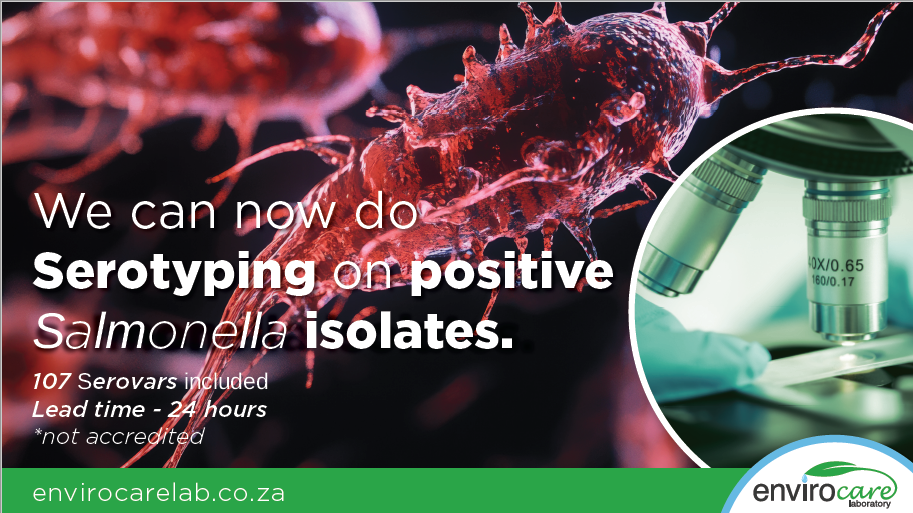
At Envirocare Laboratory, we provide rapid Salmonella serotyping for food, feed and environmental isolates, delivering results within 24 hours of isolate submission using advanced molecular methods.
What is Salmonella Serotyping?
Salmonella is a diverse bacterial genus comprising more than 2,600 recognised serovars, distinguished by their unique combinations of O (somatic) and H (flagellar) antigens using the internationally recognised Kauffmann–White classification scheme.
While a routine laboratory test confirms whether Salmonella is present, serotyping identifies the specific serovar responsible for contamination.
This additional information enables laboratories and food manufacturers to:
- Trace the likely source of contamination
- Monitor recurring contamination events
- Differentiate between persistent facility strains and new introductions
- Support HACCP, GMP and environmental monitoring programmes
- Demonstrate compliance with customer and regulatory requirements
- Assist outbreak investigations and product traceability
What is the Difference Between Salmonella Detection and Serotyping?
This is one of the most common questions asked by food manufacturers.
Salmonella detection answers:
- Is Salmonella present?
- Does the sample comply with microbiological specifications?
Salmonella serotyping answers:
- Which Salmonella serovar is present?
- Has this strain been found before?
- Is contamination recurring?
- Is the contamination linked to previous environmental or product isolates?
- Where should corrective actions be focused?
Detection tells you that contamination exists.
Serotyping helps explain why it occurred and how to prevent it from happening again.
How is Salmonella Detected in Food?
Food testing laboratories typically follow internationally recognised microbiological methods, including ISO-based culture techniques, to detect Salmonella in food, feed and environmental samples.
Testing generally involves:
- Pre-enrichment of the sample
- Selective enrichment
- Isolation on selective culture media
- Confirmation of Salmonella
- Serotyping of confirmed isolates when further identification is required
This systematic approach provides reliable detection while allowing confirmed isolates to be further characterised for investigation purposes.
How Long Does Salmonella Testing Take?
The time required depends on the type of analysis requested.
Routine Salmonella detection generally requires several days because bacteria must be enriched, isolated and confirmed using recognised microbiological methods.
Once a Salmonella isolate has been confirmed, Envirocare Laboratory can perform rapid molecular serotyping, providing serotyping results within 24 hours of isolate submission.
This significantly reduces investigation time during contamination events and enables faster corrective action.
Why is Rapid Salmonella Serotyping Important?
Rapid identification allows food manufacturers to respond quickly to contamination events before they escalate.
Benefits include:
- Faster root cause investigations
- Reduced production downtime
- Improved cleaning verification
- Better environmental monitoring
- Enhanced supplier investigations
- More informed risk assessments
- Stronger regulatory and export compliance
Applications Across Different Industries
Food Industry
Salmonella remains one of the leading causes of food recalls worldwide and can affect products including:
- Ready-to-eat foods
- Meat and poultry
- Eggs
- Dairy products
- Processed foods
- Ingredients and spices
Contamination may occur during raw material handling, processing, packaging or post-processing activities.
Rapid serotyping helps determine whether contamination originates from:
- Incoming raw materials
- Processing equipment
- Environmental reservoirs
- Cross-contamination
- Persistent resident strains
This information supports targeted corrective actions rather than broad, costly interventions.
Animal Feed Industry
Contaminated feed ingredients can introduce Salmonella into poultry and livestock production systems, creating downstream food safety risks.
Common contamination sources include:
- Raw materials
- Ingredient storage
- Feed mills
- Conveyors
- Silos
- Dust accumulation
- Biofilms
Serotyping assists feed manufacturers by:
- Identifying recurring contamination
- Evaluating sanitation effectiveness
- Supporting HACCP verification
- Improving supplier monitoring
- Reducing contamination risk throughout production
Environmental Monitoring
Environmental monitoring programmes are designed to detect contamination before it reaches finished products.
Typical sampling locations include:
- Drains
- Floors
- Equipment
- Conveyors
- Packaging areas
- Air handling systems
- High-risk processing zones
When Salmonella is detected, serotyping helps answer important questions:
- Is this the same strain found previously?
- Is contamination linked to production or raw materials?
- Has cleaning eliminated the original contamination source?
- Are multiple contamination events connected?
These insights support more effective environmental control programmes.
Envirocare Laboratory’s Rapid Salmonella Serotyping Service
Our laboratory provides rapid molecular serotyping for confirmed Salmonella isolates from:
- Food products
- Animal feed
- Environmental monitoring samples
Our service includes:
- 24-hour turnaround from isolate submission
- Identification of 107 clinically and economically important Salmonella serovars
- High analytical sensitivity and specificity
- Rapid reporting
- Technical consultation with results where required
Partner with Envirocare Laboratory
Understanding Salmonella contamination requires more than a positive or negative result. Rapid serotyping provides valuable information that supports contamination investigations, food safety management and regulatory compliance.
Whether you operate in food manufacturing, animal feed production or environmental monitoring, Envirocare Laboratory can help you gain the insights needed to make informed decisions.
Contact Envirocare Laboratory
📍 6 Du Plooy Street, Potchefstroom, 2531
📞 +27 18 294 4283
📧 info@envirocarelab.co.za
References
- Grimont, P. A. D., & Weill, F. X. (2007). Antigenic Formulae of the Salmonella Serovars (9th ed.). WHO Collaborating Centre for Reference and Research on Salmonella, Institut Pasteur.
- International Organization for Standardization. (2017). ISO 6579-1:2017 – Microbiology of the Food Chain – Horizontal Method for the Detection, Enumeration and Serotyping of Salmonella – Part 1: Detection of Salmonella spp.
- European Food Safety Authority (EFSA) & European Centre for Disease Prevention and Control (ECDC). (2024). The European Union One Health Zoonoses Report 2023.
- U.S. Food and Drug Administration. (2025). Recalls, Market Withdrawals, and Safety Alerts.
- Jones, F. T. (2011). A review of practical Salmonella control measures in animal feed. Journal of Applied Poultry Research, 20(1), 102–113.
- Codex Alimentarius Commission. General Principles of Food Hygiene (CXC 1-1969), including HACCP Principles (latest revision).
