

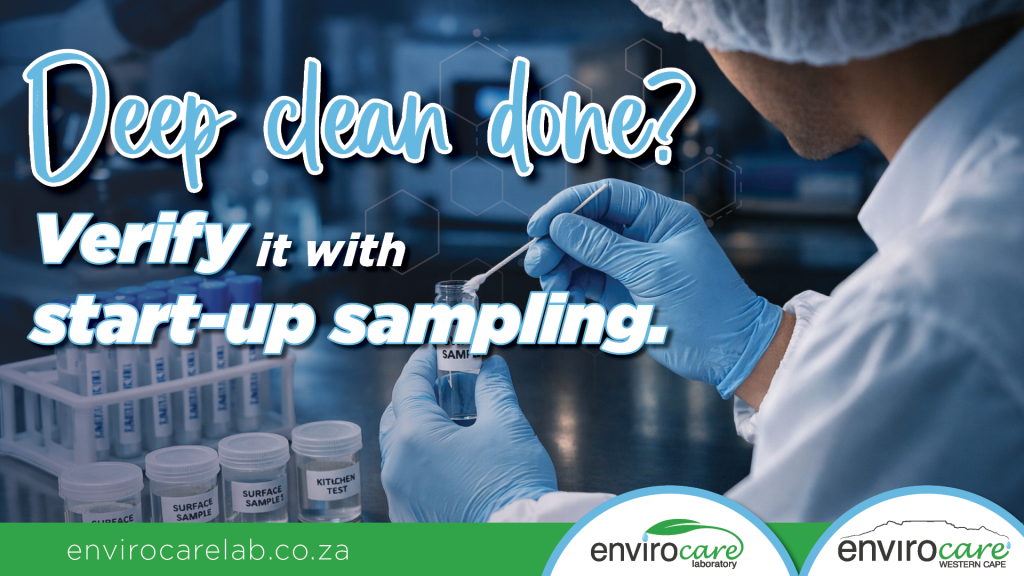
When a food manufacturing facility reopens after a festive shutdown, planned maintenance, or seasonal closure, one of the most critical food safety priorities is verifying that the production environment is truly ready for operation.
Although deep cleaning removes visible dirt and contamination, it does not confirm that microorganisms have been effectively eliminated. Without microbiological verification, bacteria, yeast, mould, or other contaminants may remain on equipment, food-contact surfaces, or within the production environment, increasing the risk of product contamination, reduced shelf life, customer complaints, or costly recalls.
This is why Start-Up Sampling forms an essential part of every food safety management programme before production begins.
What Is Start-Up Sampling?
Start-Up Sampling is a microbiological verification programme performed immediately after deep cleaning and before the first product enters the production line.
Unlike routine environmental monitoring, which measures hygiene throughout normal production, Start-Up Sampling confirms that cleaning and sanitation procedures were successful before manufacturing resumes.
The results provide documented evidence that critical food-contact surfaces, production equipment, personnel hygiene, and the surrounding environment meet acceptable microbiological standards prior to production.
By identifying contamination before production starts, corrective actions can be implemented immediately, helping to prevent food safety incidents before they occur.
Why Verify a Deep Clean?
A facility may appear visually clean while still harbouring microorganisms capable of contaminating products.
Common areas where contamination can remain include:
- Conveyors and production equipment
- Food-contact surfaces
- Drains and difficult-to-clean locations
- Packaging equipment
- High-care production areas
- Employee hands and protective clothing
- Air handling systems and production environments
Microbiological verification confirms whether cleaning has been effective rather than relying solely on visual inspection.
The Difference Between Cleaning and Verification
Many facilities mistakenly assume that completing a deep clean automatically means production can safely restart.
In reality, these are two separate processes:
Deep Cleaning removes visible soils, food residues and biofilms.
Start-Up Sampling confirms microbiologically that cleaning has achieved the required hygiene standard.
Routine Environmental Monitoring verifies that hygiene standards continue to be maintained during normal production.
Start-Up Sampling therefore bridges the critical gap between cleaning activities and safe food production.
How Envirocare Laboratory Supports Start-Up Verification
Envirocare Laboratory offers comprehensive Environmental and Hygiene Monitoring services designed specifically to verify cleaning effectiveness before production resumes.
Hygiene Swab Testing
Microbiological hygiene swabs assess food-contact surfaces, equipment and high-risk areas for residual microbial contamination after sanitation procedures have been completed.
These results help verify that cleaning programmes have effectively reduced microbial risks before production begins.
Contact Plates (RODAC Plates)
RODAC contact plates provide direct microbial counts from flat food-contact surfaces including:
- Stainless steel worktables
- Conveyors
- Filling equipment
- Packaging stations
- Processing equipment
These tests are particularly useful for validating sanitation effectiveness following shutdown cleaning.
Air Monitoring
Air monitoring assesses airborne microbial contamination within production areas before manufacturing starts.
This service is especially valuable for:
- High-care environments
- Ready-to-eat production
- Packaging facilities
- Clean processing areas
Personnel Hygiene Verification
Returning employees can unintentionally introduce contamination into production areas.
Hand swab testing verifies that hygiene practices are effective before production resumes and supports Good Manufacturing Practice (GMP) programmes.
Equipment Sanitation Verification
Targeted sampling of production equipment confirms that cleaning and sanitation procedures have effectively removed microbial contamination from critical processing equipment before product contact.
Benefits of Start-Up Sampling
Implementing Start-Up Sampling provides several important advantages for food manufacturers:
- Confirms the effectiveness of deep cleaning programmes
- Detects contamination before production starts
- Reduces the risk of product contamination and recalls
- Supports HACCP prerequisite programmes
- Demonstrates due diligence during customer and regulatory audits
- Provides documented microbiological evidence of cleaning verification
- Establishes a hygiene baseline for ongoing environmental monitoring
- Supports continuous improvement within food safety management systems
Supporting Food Safety Compliance
Microbiological verification through Start-Up Sampling supports compliance with recognised food safety standards, including:
- ISO 22000 Food Safety Management Systems
- FSSC 22000 certification requirements
- HACCP programmes
- Good Manufacturing Practices (GMPs)
- Retailer food safety standards
- Customer hygiene verification programmes
Rather than relying solely on cleaning records or visual inspections, documented microbiological results provide objective evidence that sanitation procedures have been effective.
Why Choose Envirocare Laboratory?
Envirocare Laboratory provides specialised Environmental and Hygiene Monitoring services to food manufacturers, abattoirs, dairies, beverage producers, packhouses and food processing facilities throughout South Africa.
Our services include:
- ISO/IEC 17025:2017 accredited microbiological testing
- Experienced food microbiology specialists
- Rapid turnaround times
- Accurate and reliable laboratory results
- Practical support for environmental monitoring programmes
- National laboratory support for food safety compliance
Whether your facility is reopening after a festive shutdown, scheduled maintenance or seasonal closure, Start-Up Sampling provides confidence that your production environment is ready for safe food manufacturing.
Verify Your Deep Clean Before Production Begins
Cleaning is only the first step. Verifying that your facility is microbiologically ready for production is what protects your products, your customers and your brand.
Start-Up Sampling provides the scientific evidence needed to confirm that sanitation has been effective before production resumes, helping your business begin every production cycle with confidence.
Contact Envirocare Laboratory
Potchefstroom Laboratory
Tel: +27 18 294 4283
Email: info@envirocarelab.co.za
Western Cape Laboratory
Tel: +27 82 343 9579 | +27 81 834 7198
Email: info_westerncape@envirocarelab.co.za
Website: https://envirocarelab.co.za/
References
- Codex Alimentarius Commission. (2022). General Principles of Food Hygiene (CXC 1-1969, Rev. 2022). Rome: FAO/WHO.
- EHEDG. (2021). Guidelines on Hygienic Design and Cleaning Validation in Food Processing.
- FSSC Foundation. (2023). FSSC 22000 Scheme Version 6.
- ICMSF. (2018). Microorganisms in Foods 7: Microbiological Testing in Food Safety Management. Springer.
- International Organization for Standardization. (2017). ISO/IEC 17025:2017 – General Requirements for the Competence of Testing and Calibration Laboratories.
- International Organization for Standardization. (2018). ISO 22000:2018 – Food Safety Management Systems – Requirements for Any Organization in the Food Chain.
- South African Department of Health. (2018). Regulations Governing General Hygiene Requirements for Food Premises, the Transport of Food and Related Matters (R638).
