

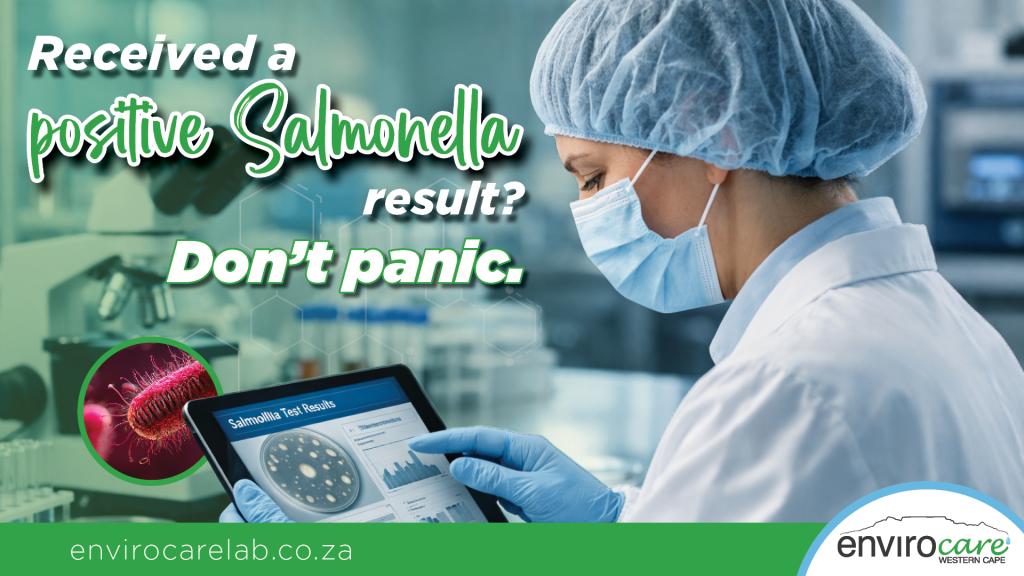
Receiving a positive Salmonella test result can be concerning for food manufacturers, processors, packhouses, abattoirs, retailers, and quality assurance teams. However, a positive result does not automatically mean there is a major food safety incident, a product recall, or a notifiable disease.
An initial laboratory test simply confirms that Salmonella species have been detected in the sample. It does not, on its own, provide the full picture needed to determine the level of risk or the most appropriate course of action.
Understanding what a positive result actually means can help your business avoid unnecessary panic, costly decisions, and production delays.
At Envirocare Western Cape Laboratory, we help clients interpret their results, understand the implications, and determine the most appropriate next steps through accredited microbiological testing and expert technical support.
What Does a Positive Salmonella Test Mean?
A positive Salmonella test means that Salmonella bacteria have been detected in the sample submitted for analysis. This may include:
- Food products
- Raw materials
- Environmental swabs
- Water samples
- Hygiene monitoring samples
- Food contact surfaces
Detection is an important first step in protecting food safety. However, the result should always be considered alongside factors such as the type of product, where the sample was collected, production history, environmental monitoring trends, and any previous microbiological findings.
A positive result is the beginning of an investigation—not necessarily the conclusion.
Don’t Rush Into Major Decisions
Receiving a positive result can understandably lead businesses to consider immediate actions such as:
- Destroying product
- Halting production
- Initiating a product recall
- Conducting emergency sanitation
- Notifying customers
While these actions may be appropriate in certain circumstances, making decisions before understanding the complete situation can result in unnecessary operational disruption and financial losses.
Each positive result should be evaluated carefully using laboratory evidence, production records, risk assessments, and your food safety management system.
What Happens After a Positive Result?
Once Salmonella has been detected, the appropriate next steps will depend on several factors, including:
- The type of sample tested
- The affected product or production area
- Customer or regulatory requirements
- Previous monitoring results
- Your corrective and preventive action (CAPA) procedures
In some situations, additional laboratory testing may be recommended to provide more information about the detected isolate. This helps food safety professionals better understand the finding and supports evidence-based decision-making.
For example, laboratories may recommend Salmonella serotyping to identify the specific serovar present where further characterisation is required. This specialised testing provides additional information that can assist with investigations, risk assessment, and regulatory decision-making. You can read more about this process in our dedicated article on Salmonella Serotyping.
Why Expert Interpretation Matters
Laboratory reports provide valuable scientific information, but interpreting those results within the context of your operation is equally important.
Expert technical guidance can help you:
- Understand what the laboratory findings indicate
- Assess the potential food safety implications
- Support root cause investigations
- Plan appropriate corrective actions
- Maintain confidence during customer or regulatory enquiries
- Strengthen your HACCP and food safety management system
The goal is to make informed decisions based on evidence rather than assumptions.
Frequently Asked Questions
Does a positive Salmonella test always mean the food is unsafe?
Not necessarily. A positive result confirms that Salmonella has been detected in the sample tested. The significance of that finding depends on factors such as the sample type, product involved, production environment, and any additional laboratory investigations that may be required.
Should I immediately recall my product?
Not every positive Salmonella result automatically requires a recall. Appropriate action should be based on a structured risk assessment, applicable regulations, customer requirements, and advice from qualified food safety professionals.
What should I do after receiving a positive Salmonella result?
Review the laboratory report, isolate any affected product where appropriate, investigate the possible source of contamination, consult your food safety team, and discuss the findings with your laboratory to determine whether additional testing or corrective actions are recommended.
Can additional laboratory testing help?
Yes. Depending on the circumstances, further laboratory analysis may provide additional information to support investigations and help guide appropriate corrective actions.
Contact Envirocare Laboratory
Potchefstroom Laboratory
Tel: +27 18 294 4283
Email: info@envirocarelab.co.za
Western Cape Laboratory
Tel: +27 82 343 9579 | +27 81 834 7198
Email: info_westerncape@envirocarelab.co.za
Website: https://envirocarelab.co.za/
References
- Centers for Disease Control and Prevention (CDC). (2024). Salmonella. https://www.cdc.gov/salmonella/index.html
- World Health Organization (WHO). (2023). Salmonella (Non-typhoidal). https://www.who.int/news-room/fact-sheets/detail/salmonella-(non-typhoidal)
- ISO 6579-1:2017. Microbiology of the food chain — Horizontal method for the detection, enumeration and serotyping of Salmonella — Part 1: Detection of Salmonella spp.
- Food and Agriculture Organization of the United Nations (FAO) & World Health Organization (WHO). (2023). Risk Assessments of Salmonella in Food. https://www.fao.org/food-safety
