


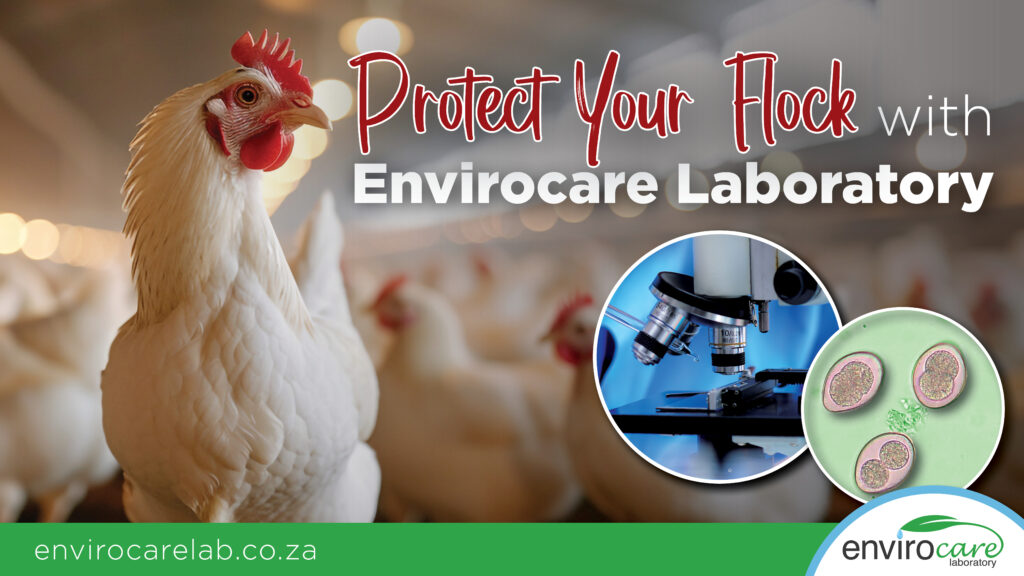
Oocyst counting in chicken faeces is one of the most important diagnostic tools for managing coccidiosis in poultry. This parasitic disease, caused by protozoa of the genus Eimeria, is one of the leading health challenges facing the poultry industry. Coccidiosis can result in poor growth, reduced feed efficiency, increased mortality, intestinal damage, and significant financial losses for poultry producers.
By monitoring the number of oocysts per gram (OPG) in faecal samples, farmers and veterinarians can assess infection levels, evaluate the success of vaccination and anticoccidial programmes, and take timely action to protect flock health and productivity. Across South Africa, routine oocyst monitoring has become an essential component of modern poultry health management.
What is Coccidiosis in Poultry?
Coccidiosis is an intestinal disease caused by several species of Eimeria parasites that infect chickens and other poultry. The parasites multiply within the intestinal lining, damaging the digestive tract and reducing the bird’s ability to absorb nutrients efficiently.
The disease can affect birds of all ages but is particularly common in young broilers and replacement pullets. Even when birds do not show obvious clinical signs, subclinical infections can reduce weight gain, worsen feed conversion ratios, and negatively impact overall flock performance.
Symptoms of Coccidiosis in Poultry
Recognising the early signs of coccidiosis allows producers to act before major production losses occur. Common symptoms include:
- Bloody or watery diarrhoea
- Reduced feed and water intake
- Poor weight gain
- Poor feed conversion
- Depression and lethargy
- Ruffled feathers
- Dehydration
- Increased mortality in severe infections
Because these symptoms may resemble other poultry diseases, laboratory testing is essential for an accurate diagnosis.
Why Oocyst Counting Matters
The oocyst per gram (OPG) count provides a direct indication of the coccidial burden within a flock. Routine monitoring helps producers make informed management decisions before clinical disease develops.
Benefits of routine oocyst counting include:
- Assessing the severity of infection
- Evaluating vaccine and anticoccidial programme effectiveness
- Detecting subclinical infections before production losses occur
- Monitoring possible anticoccidial drug resistance
- Guiding targeted treatment decisions
- Assessing farm hygiene and litter management
- Monitoring long-term flock health trends
Regular testing enables farmers to identify increasing parasite pressure early and implement corrective measures before productivity is affected.
Understanding OPG Results
Interpreting OPG counts helps determine whether intervention may be required.
Less than 5,000 OPG
- Low parasite burden
- Mild exposure
- Usually no clinical signs
5,000 – 50,000 OPG
- Moderate infection
- Possible reduction in feed intake
- Mild diarrhoea
- Reduced growth performance
Greater than 50,000 OPG
- Heavy infection
- High risk of clinical coccidiosis
- Immediate veterinary investigation and treatment may be required
OPG results should always be interpreted together with flock age, vaccination history, clinical signs, and veterinary assessment.
Treatment of Coccidiosis in Poultry
Early diagnosis plays a critical role in successful coccidiosis treatment. Once an infection has been confirmed, a veterinarian may recommend an appropriate anticoccidial treatment programme based on the severity of the infection and the flock’s management history.
Routine oocyst counting supports treatment by:
- Confirming the presence of coccidial infection
- Determining the severity of the infection
- Monitoring the effectiveness of treatment
- Detecting recurring infections
- Helping evaluate potential resistance to anticoccidial products
Follow-up testing after treatment provides valuable information on whether parasite levels have decreased and whether further intervention may be necessary.
Coccidiosis Prevention
Effective coccidiosis control requires an integrated management approach. Oocyst counting is one component of a comprehensive prevention programme that includes:
- Strong biosecurity practices
- Good litter management
- Regular cleaning and sanitation
- Vaccination programmes
- Responsible use of anticoccidial medications
- Routine laboratory monitoring
- Veterinary oversight
Combining these strategies helps reduce disease pressure while supporting sustainable poultry production.
Accurate Oocyst Counting with Envirocare Laboratory
Envirocare Laboratory provides fast, accurate, and reliable oocyst counting services to support poultry farmers, veterinarians, and poultry integrators throughout South Africa.
Our service includes:
✔ Rapid turnaround times for timely management decisions
✔ Advanced microscopy with digital imaging for accurate parasite identification
✔ Morphological assessment to assist with Eimeria species differentiation
✔ Detailed laboratory reports that support informed treatment and management decisions
Our experienced laboratory team delivers dependable diagnostic information that helps poultry producers detect problems early, reduce production losses, and improve flock performance.
Conclusion
Routine oocyst counting remains one of the most valuable tools for diagnosing and managing coccidiosis in poultry. Regular monitoring allows producers to detect infections early, evaluate treatment effectiveness, reduce economic losses, and improve flock health and productivity.
When combined with good biosecurity, vaccination programmes, responsible anticoccidial use, and veterinary guidance, routine laboratory testing provides a proactive approach to poultry disease management.
Whether you are managing broilers, breeders, or layer flocks, Envirocare Laboratory is committed to delivering fast, accurate diagnostic services that help poultry producers across South Africa maintain healthy, productive flocks.
Contact Envirocare Laboratory
Telephone: +27 18 294 4283
Email: info@envirocarelab.co.za
Website: https://envirocarelab.co.za
References
- Blake, D. P., & Tomley, F. M. (2014). Securing poultry production from the ever-present Eimeria challenge. Trends in Parasitology, 30(1), 12–19. https://doi.org/10.1016/j.pt.2013.10.003
- Chapman, H. D. (2009). A landmark contribution to the understanding of avian coccidiosis. Poultry Science, 88(4), 813–815. https://doi.org/10.3382/ps.2008-00274
- Chapman, H. D., Barta, J. R., Blake, D., Gruber, A., Jenkins, M., Smith, N. C., Suo, X., & Tomley, F. M. (2013). A selective review of advances in coccidiosis research. Advances in Parasitology, 83, 93–171. https://doi.org/10.1016/B978-0-12-407705-8.00002-1
- Conway, D. P., & McKenzie, M. E. (2007). Poultry Coccidiosis: Diagnostic and Testing Procedures (3rd ed.). Blackwell Publishing.
- McDougald, L. R., & Fitz-Coy, S. H. (2020). Coccidiosis. In D. E. Swayne (Ed.), Diseases of Poultry (14th ed.). Wiley-Blackwell.
- Shirley, M. W., Smith, A. L., & Blake, D. P. (2007). Challenges in the successful control of the avian coccidia. Vaccine, 25(30), 5540–5547. https://doi.org/10.1016/j.vaccine.2006.12.030
- Williams, R. B. (1999). A compartmentalised model for the estimation of the cost of coccidiosis to the world’s chicken production industry. International Journal for Parasitology, 29(8), 1209–1229. https://doi.org/10.1016/S0020-7519(99)00086-7
- World Organisation for Animal Health (WOAH). (2023). Manual of Diagnostic Tests and Vaccines for Terrestrial Animals. Available at: https://www.woah.org
- Merck Veterinary Manual. (2024). Coccidiosis in Poultry. Available at: https://www.merckvetmanual.com
- Food and Agriculture Organization of the United Nations (FAO). (2023). Good Practices for Biosecurity in the Poultry Sector. Available at: https://www.fao.org
